Be surprised!

Every so often, a neighbor will invite me to talk about local trails. Once I start on that topic, I don’t know when to quit. When we move from talk to walk, I keep going: here’s this feature, there’s that feature. Sometimes nature itself has to shut me up with the surprises it keeps in store.

This week, I went with a community TV videographer to Horse Hill Nature Preserve. I suggested that we meet at a pond on the property, so that some springtime video footage would provide a good backdrop to the feature she was producing.

That was a silly thought. As was right and proper, I provided the backdrop while the pond provided the feature presentation.

(The finished video, “Trailblazers,” is available for viewing on the Merrimack TV site and app. Great work by my town’s community television crew, as usual!)

A ribbon snake in vegetation at the edge of a pond
Ribbon snake. All photos in post by Ellen Kolb.

As the videographer started to set up her camera’s tripod near the pond’s edge, a ribbon snake came out of its hidey-hole practically at our feet to see what was going on. We stopped what we were doing and watched the slim creature for awhile, as it watched us. It didn’t seem impressed. After a quiet couple of minutes, it disappeared into some thick grass. As the little snake departed, I noticed a little tuft of bluets nearby, the first of the season’s wildflowers.

Small blue flowers growing as ground cover in the spring season
Bluets

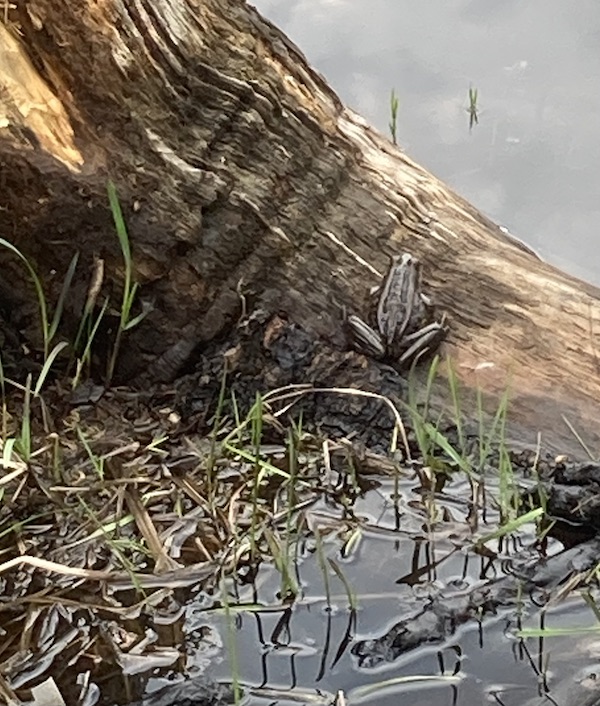
I knelt at the water’s edge to see if I could catch sight of some frogs or dragonflies. Clumsy as I am, I startled away a couple of frogs who jumped into the water when they saw me coming. But hey! A few feet away, my companion spied a frog who stayed put, practically posing for a photo.

The heron rookery was full of action. (This post includes a photo of the same rookery taken in another season when I had a better camera with me.) If the babies have hatched, they were laying low the morning we were there. The adults in the nests were croaking at the noisy geese in the pond. At one point, two herons took off to chase away a hawk that was performing a leisurely flyover to see what tasty morsels might be tucked away in the nests. That hawk had nerve, but not nerve enough to stick around when a pair of birds with six-foot wingspans came after it.

We came looking for a backdrop for an interview. Instead, the pond spoke for itself. All we had to do was stand still and let ourselves be surprised.

Light rain began to fall as we finished up. Nothing stormy. It was a grace note to the jazzy little riff nature had just played for us.

Looking down: spring wildflowers

My spring hiking has been hobbled – literally – by a bruised knee. Sounds trivial, but it’s a nuisance. No hilltop vistas for me in May. Fortunately, with rail trails and local conservation areas, I’ve had options. And May was a month for wildflower hikes.

April showers did exactly what the old rhyme says they do. Before taller plants were ready to flower, ground covers were blooming. I appreciate the tiny flowers that announce the end of mud season. I love the way their colors punctuate the season’s new growth. Certain flowers seemed to be everywhere I walked: purple fringed polygala, starflower, bluets.

Others were harder to find. In the conservation area closest to my house, I searched in vain for two weeks for trillium before finding a single one. I spotted no lily of the valley until the last week of the month.

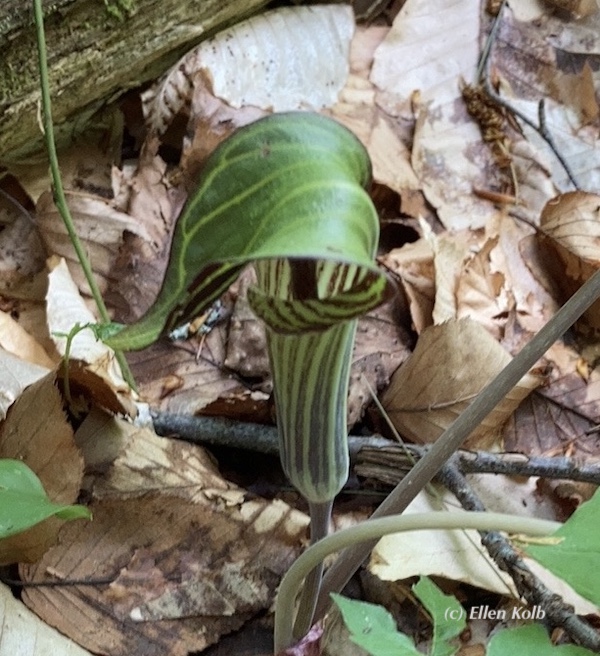
To my delight, I did find a jack-in-the-pulpit on a trail in the next town over. That odd little plant might be everywhere, but I hadn’t spotted one before. It’s just a few inches high. I only found it because it was tucked right next to a particularly vigorous shoot of poison ivy, and its foliage didn’t seem to match. I carefully nudged the poison ivy’s leaves aside and was rewarded with the day’s prize sighting.

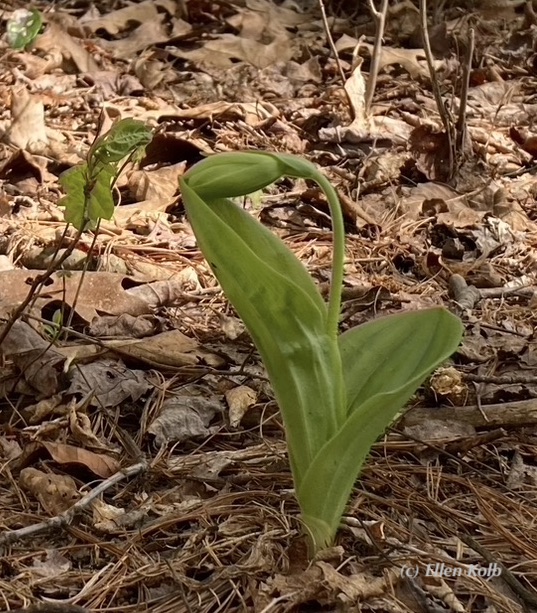
The ladyslippers always seem to spring out of nowhere in May. This has been a good year for them. A friend sent me an email one day about a certain trail we like, saying “ladyslipper alley coming next week.” Indeed! One day they were nowhere in sight even though I knew I was standing where I’ve seen them in other years. A week later, I spied a few pairs of ladyslipper leaves cautiously stretching out as though they were reluctant to give up shielding the flower stalks inside. Within just a few days, the stalks were upright, each one a good eight inches high or more, each bearing a striking blossom. Nothing tiny or modest about these ephemeral spring beauties. They show off like divas for two weeks, then it’s goodbye until next year.

Garlic mustard, an unwelcome guest.

Not everything blooming in spring is delightful. Invasive plants along my local trails threaten to overpower native vegetation. I found a patch of unfamiliar flowers making themselves at home at a nearby trailhead. A phone app backed up by some information from UNH’s Cooperative Extension service helped me identify the plant as garlic mustard. That inoffensive-looking pest will spread all over the forest floor if it’s left unchecked, crowding out the woodland wildflowers. I pulled up what I could, and I’ll be back to pull some more, disposing of it in the trash and definitely not in the compost pile.

June might see me back on the hills as my knee heals. I call North Uncanoonuc in Goffstown my rehab hill, because that’s the first place with any elevation that I go to post-injury. I hope to be there soon.

All photos by Ellen Kolb.

If you enjoy Granite State Walker, I hope you’ll consider supporting the blog. Thank you!

Cusp of spring

My favorite garden center opened for the season yesterday. I picked up one pot each of forced narcissus and hyacinths to put in my front window. No reason, really, except that I want something colorful to look at while the hickory and elm trees outside are still looking drab.

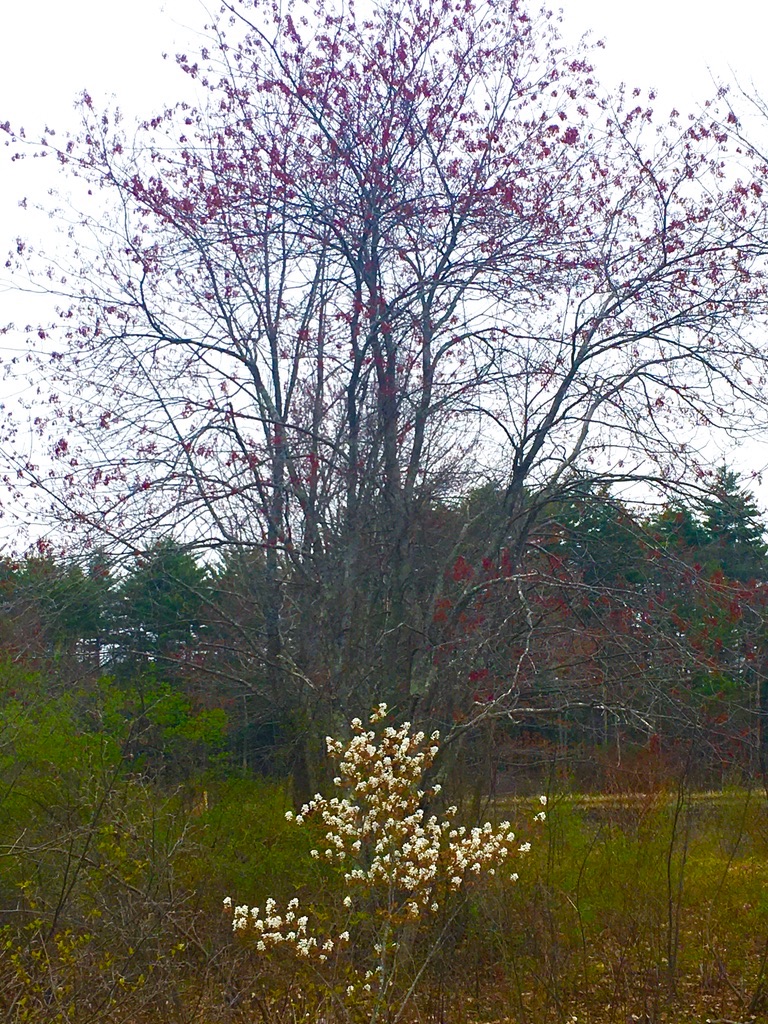
A few more weeks and the drab of winter will be past. Buds are swelling. I walked in Concord today on a trail along the Merrimack River. Around me were bare shrubs, bare trees, and fields of corn stubble. But something further away caught my eye: an island in the middle of the meandering river, with trees adorned with cloud-like pale-red streaks. Maples, of course, flowering earlier than all the other trees. Delightful.

Early April, Merrimack River: looks like spring is coaxing the maples along. Ellen Kolb photo.

The trail was in good shape, with very little mud. That’s not the case everywhere in southern New Hampshire, and mud season makes it challenging for me to pick good places to walk. The bugs aren’t out in force yet, though, which is a plus.

Soon I won’t have to look past my yard for flowering trees and unfolding leaves. That means my spring allergies will soon flare up. Worth it, though.

For now, I like being on the cusp of spring. The tom turkeys in my neighborhood are mightily displaying their plumage in an attempt to impress the hens. My neighbor on the sunnier side of the street is tending to the gorgeous little patch of crocuses blooming in her yard. The herons are back at their rookery. And of course the peepers are out now – the tiny tree frogs whose springtime call sounds like a chorus of little bells.

Using mud season to plan ahead

New Hampshire’s mud season is here, thanks to a month that has brought days of snow alternating with days of 50 degrees. I went to the forest trails in one of my favorite Concord parks the other day, and I turned around after about a hundred yards. Squishy ground is not ideal for hiking. Turns out hiking isn’t ideal for squishy ground, either. Ask any trail maintainer. I’m switching to pavement for the time being.

Paved bike trail in wooded area, with old brick industrial building in background
March 2022: Nashua River Rail Trail, Dunstable MA. Clear pavement, muddy edges. Ellen Kolb photo.

While I’m putting in the miles on roads and paved trails, I’ll be giving some thought to the maintenance work and spring cleanup that will be going on as the weather gets warmer and the mud dries up. This is a good time for trip planning, too.

I serve on my town’s conservation commission, on a subcommittee dedicated to one of the town’s nature preserves. We’ve been keeping an eye on some areas being taken over by invasive plants that are crowding out native species. In consultation with an expert from the local university’s extension program, we’re coming up with a management plan to tackle the invasives later in the year. Planning now will pay off later.

My favorite local paved trail, the Nashua River Rail Trail, has obviously seen recent work from volunteers who have already made the most of mud season. While the side paths in the woods are still muddy and soft, working on the pavement is easy. Between my last two visits to the northern section of the trail, a crew or crews had been through to clear away fallen branches and pick up trash.

I’m gathering trail information this month for a multi-day hike later in the year on the rail trails in the southwestern part of New Hampshire. I don’t feel quite so stuck during mud season when I know there’s a trip ahead to plan and train for.

Mud season might give you time to learn more about the trails in your area, even if they’re temporarily off limits until things dry up a bit. Is a trail owned or managed by your town? Check with the Parks and Recreation department or the municipal Conservation Commission to find out if there are opportunities for you to volunteer for upcoming events. Are you fond of a certain rail trail? The New Hampshire Rail Trails Coalition website contains links to many local trail clubs, each with its own projects and schedule. Don’t dismiss Facebook; it’s still a great way to find groups organized around a specific trail or park. Those Facebook groups are often the best source of information on up-to-date trail conditions and maintenance needs.

Avoiding the trails for another couple of weeks will be good for them. Using the time for planning ahead will be good for me.

More travel, more trails

After a COVID-influenced year of curtailing my activities, I’m keeping some appointments that don’t involve videoconferencing. One benefit to out-of-town drives is that I’ve been able to check out new trails. On one day I had just enough spare time to sample the Winnipesaukee River Trail in Tilton. Another day, during a Seacoast trip, I enjoyed a tripleheader of varied paths. A more routine errand to the Manchester Airport gave me an excuse to see how the Londonderry Trail looks in spring.

Winnipesaukee River, Tilton. Ellen Kolb photo.

Winnipesaukee River Trail

This is not to be confused with the Winni Trail, where the “Winni” stands for “Winnisquam.” The Winnipesaukee River Trail may someday connect with Winni, though, if several links are developed. Like Winni, the Tilton segment is rail-with-trail.

The Winnipesaukee River Trail goes from Franklin to Tilton via Northfield, with a little bit of road walking included. I recently visited the easternmost mile. Parallel and very close to U.S. 3, the path is surprisingly quiet, shielded by a row of buildings from some of the traffic noise. The river was pretty but quiet due to lack of rainfall; a depth indicator painted on a bridge abutment was well above the current water level.

A lengthier visit extending to Franklin would have been more rewarding, but my time was limited. I enjoyed a peaceful half-hour along the river. My turnaround point was startling, after the quiet walk: the commercial cluster by exit 20 on I-93. Had I wanted a snack, that would have been a place to consider, with the trail’s terminus flanked by fast-food places. My starting point had some options as well, with U.S. 3 serving as Tilton’s Main Street.

The Winnipesaukee River joins the Pemigewasset River in Franklin to form the Merrimack, the waterway that defines south-central New Hampshire.

Winnipesaukee River rail-with-trail in Tilton NH. Photo by Ellen Kolb.
Rail-with-trail in Tilton. Ellen Kolb photo.

Rochester and Dover

I rarely get to Strafford County. When I did earlier this month, I visited three very different trails.

The Farmington Rail Trail extends from the town of Farmington to the city of Rochester near Spaulding High School, roughly paralleling NH Route 11. I had been warned that it was sandy enough to leave even fat-tire bicyclists in despair. Being a walker, I dismissed that concern. Silly me. It was like walking on a beach, giving my legs more of a workout than I’d bargained for. I probably needed that anyway.

Next stop: the Lilac City Greenway, short and sweet. The northern portion of it runs along Rochester’s main drag, serving as a sidewalk. It’s paved, nicely landscaped for spring, and adorned with abstract sculptures. I benefited from a combination of Charles Martin’s guidebook and Google Maps, which warned me that the municipal parking lot close to the greenway is accessible only to northbound traffic on Route 125.

Lilac City Greenway in Rochester, NH
Lilac City Greenway, Rochester NH. Photo by Ellen Kolb.

Then, south to Dover. Without realizing it, I’d saved the best for last. The Dover Community Trail, developed relatively recently, was wide and quietly scenic. I parked at the western end, at the Watson Road trailhead. The fairly large parking lot (room for about 20 cars) was nearly full when I arrived at midday on a workday. Even so, there was no sense of crowding on the wide, well-packed trail that extends about three miles to the center of Dover.

The Cocheco River flowed alongside the trail, and several anglers in hip waders were trying their luck. I was passed by a few lunch-hour runners, and in turn I passed a few easygoing dog walkers. My map told me that offices for county government and a large insurance company were nearby, but they were completely out of sight and sound, built on higher ground.

Cocheco River, Dover NH. Photo by Ellen Kolb.
Cocheco River beside Dover Community Trail. Ellen Kolb photo.

I’m sure the downtown end of the trail has a much livelier character. I wasn’t looking for lively that day. The Watson Road trailhead was the right place for me to start my walk.

Londonderry

Here’s a familiar destination for me: Londonderry Rail Trail from the Harvey Road/Airport trailhead. What did it look like on a drizzly spring morning? Delightful. A film of pollen glazed portions of Cohas Brook reservoir, but the trees in flower looked so good that I didn’t mind all the allergens floating around.

There are plenty of “destination” trails in New Hampshire worth a full day’s exploration, but I value quick trail stops, too. They can give a busy day a special kind of spark.

Flowering tree and shrub, springtime, Londonderry Rail Trail, New Hampshire.
Springtime on Londonderry Rail Trail, at Little Cohas Brook Reservoir. Ellen Kolb photo.

Subtly Spring

“Show me some spring pictures,” a reader recently asked me. He was looking for budding trees and fresh green growth. Perhaps I can oblige him in another week or so. For now, the signs of spring are subtler.

It’s mud season, but the trails at Horse Hill Nature Preserve in Merrimack were in remarkably good shape the other day. The herons were back on Lastowka Pond, croaking and courting. I could see that the beavers had been busy along the shoreline, taking down a big tree that barely missed a bench as it fell. Deeper into the woods, I smelled freshly-cut lumber on a refurbished bog bridge.

Simple wooden bridge on forest trail
Early-season work by trail maintainers: a refurbished bridge. Photos by Ellen Kolb.
Trees with beaver damage
The beavers are in town: this pair of trees had been untouched a week earlier.

On a recent walk through Mine Falls Park in Nashua, I looked for swans in the cove but found none. Some years, there’s a pair that bullies the park’s Canada geese into the cove’s farther reaches. The geese are safe for now. I was glad to see blackbirds amid the reeds that edge the cove; I missed them in winter.

Blackbird amid reeds
Blackbird, nearly hidden in reeds

Business took me to Loudon recently, and I added a couple of hours to the trip so I could visit nearby Belmont and discover the Winni Trail, a paved rail trail along Lake Winnisquam. That was one of my better detours.

Winni trail logo, Belmont NH

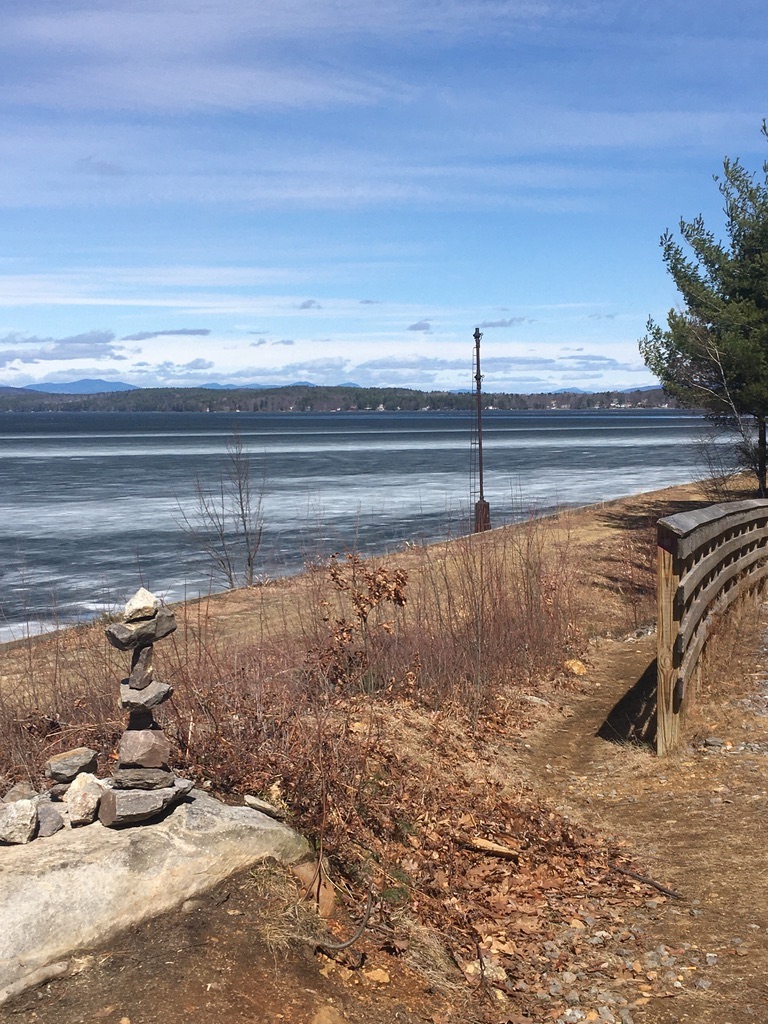
I had the advantage of a fine sunny day, with cool air and miles of visibility. A stretch of trail went through the woods, with lake and rail line out of sight, and then broke into the open to hug the shore alongside the rails. Good thing someone thought to set up a few benches along the way; the views are definitely worth stopping for.

Lake Winnisquam, Belmont, New Hampshire, from rail trail
Seen from the Winni Trail: a railroad signal mast, Lake Winnisquam, and the hills of the Lakes Region.

It was my first experience with rail-with-trail, where a trail shares the right-of-way with an active rail line. That particular line is owned by the state of New Hampshire, not by a rail corporation, and I suppose that might have simplified development of the trail.

The shared right-of-way continues into Laconia on the WOW Trail (for Lakes Winnisquam, Opechee, and Winnipesaukee). Someday, with a lot of cooperation and investment and volunteer work, there could be a continuous recreational rail trail linking WOW in Laconia with the Winnipesaukee River Trail in Tilton via the Winni Trail in Belmont. That’s a project to cheer for, if Belmont’s trail is indicative of what’s ahead.

Winni trail, rail trail in Belmont New Hampshire, in early spring.
Early spring on the Winni Trail