Too Much Traffic: When a Park Gets Too Much Love

I’ll start with my conclusion: if the parking lot at your intended trailhead is full, keep driving. Please.

What’s happening in my own New Hampshire town is surely happening elsewhere, as the Covid pandemic affects outdoor recreation. A recent online meeting of the conservation commission, normally an under-the-radar board, drew plenty of viewers and plenty of questions (submitted in advance by email). Topic: what’s to be done with Wildcat Falls? (Update, 2025: the property is now called the Wildcat Conservation Area.)

Wildcat Falls is one of the main conservation lands in town with a trail network. It’s along the Souhegan River, not far from where I live. In ordinary times, the small parking lot can accommodate the manageable number of people who come to walk their dogs, birdwatch, or enjoy sunning themselves by the falls that give the area its name.

Then came the pandemic. The neighboring state of Massachusetts has been hit much harder than New Hampshire, and accordingly has had more restrictions on recreation. So did Massachusetts residents stay home and wait for things to clear up? No, they did not. (And neither would I, in their place.) They headed over the border and discovered some of the little southern New Hampshire parks I’ve been raving about for years.

That has meant a lot more action in Wildcat Falls. Combine our visitors with the locals who already love the place, and Wildcat’s being loved to death.

This conservation land is adjacent to a residential area. What happens when the visitor census explodes? The visitors to the conservation land park on the local streets, blocking driveways and fire hydrants, and narrowing the streets to the point where emergency access – say, by a fire engine – could be impossible.

The conservation commission meeting was specially scheduled to give people a forum to vent about the parking, noise, and public health problems created by the additional visitors. No decisions were made that evening. There were plenty of suggestions, though, ranging from “tow the cars” to “close the park.” I’m not sure from what direction a solution will come, but for now, I am avoiding the area and taking my walking shoes elsewhere.

The Forest Society is coping with the too-much-love phenomenon at Mount Major, one of their properties that is extremely popular anytime but has become a major (no pun intended) draw for people whose other recreational options have been limited. Aerial footage of the road leading to the parking lot has made me wince, with cars parked along the road as far as the eye can see.

The Forest Society, blessed with numerous properties statewide, has responded by publicizing some of its less-visited reservations as alternatives to the hot spots. Good solution.

New Hampshire State Parks have resorted to a reservation system for popular spots like Monadnock and Pawtuckaway. It’s a little grating to me have to go online for a parking pass in advance, but not as grating as having the parks closed altogether – which was the situation for awhile.

I have put serious mileage on my walking shoes since the Covid pandemic began affecting our health and blowing our routines to pieces. Getting outside has been absolutely essential to keeping me on an even keel. I get it: a lot of my neighbors, including my neighbors south of the nearest border, are in the same position.

But, please…when a trailhead parking lot in a residential neighborhood is full, let’s find someplace else to go. Quite aside from public health concerns, the neighbors will be grateful.

Update: a month after I wrote this post, the Merrimack Town Council voted after lengthy consideration to close the Wildcat Falls conservation area temporarily. The area has since re-opened as Wildcat Conservation Area, and additional parking is available at Watson Park, a half-mile away by trail.

Related: I wrote Keeping It Local with some ideas for finding less-traveled trails in southern New Hampshire.

A Covid challenge: keeping hikes local

For my readers in New Hampshire’s southern tier, itching for recreation as the COVID-19 pandemic turns everything upside down, this might be a good time to review the nearby spots where we can walk and decompress.

Go ahead. Get out there. It’s worth the effort to find an uncrowded place to walk. Aim for solitude instead of isolation (there’s a world of difference). Social distancing is important, and some of us need to stay extremely close to home, but don’t rule out every outdoor option. Remind yourself that it’s spring, even if this seems like a crazy time. The peepers are waiting for you. The pollen may have found you already.

Can’t get out now? Plan for future hikes. The current unpleasantness is temporary.

DSCF2279
Oak Hill Trails, Concord NH
  • What are your favorite spots in your own town? Are the trailhead parking lots full?Maybe there’s a new park to discover nearby. Look up Parks and Rec or Conservation Commission on your city or town website. You may find trail descriptions and maps available for download.  Maybe there’s a newly-acquired property you haven’t heard about yet.
  • Facebook and Instagram can be gold mines of information on current trail conditions. Follow or “like” pages such as Friends of the Goffstown Rail Trail and Londonderry Trailways (to give just two examples). You might find reports that one trail is experiencing too-heavy use on a particular day, while another one five miles away is much quieter.
  • The Forest Society has more than a hundred properties statewide for you to discover. Forget the one on Mount Major, where the parking lot looks like a mall on Black Friday. That still leaves a bunch of beauties, and there’s probably one near you. Website bonus: virtual tours, where you can check out properties online and plan for future hikes.
  • There’s probably a New Hampshire state park near you. There might be some access limitations.
  • This isn’t the time to push any physical limits. First responders have enough to do at the moment without fetching injured hikers.
Stratham Hill Park, Stratham NH: a guide to what you can see from the observation tower.

Are you avoiding even solo road trips? Join the club. I’m lucky to have a walkable neighborhood: no sidewalks, but no through-roads, either. That’s where I’ve done most of my walking for the past couple of weeks. I find that a daily walk is an absolute necessity, not so much for the physical exercise as for the mental shift.

Bonus for the soul: I’m seeing neighbors I’ve never met, who are also trying to fight the shut-in feeling that comes with these days. We observe social-distance protocols. The six-foot rule does not bar smiles and greetings.

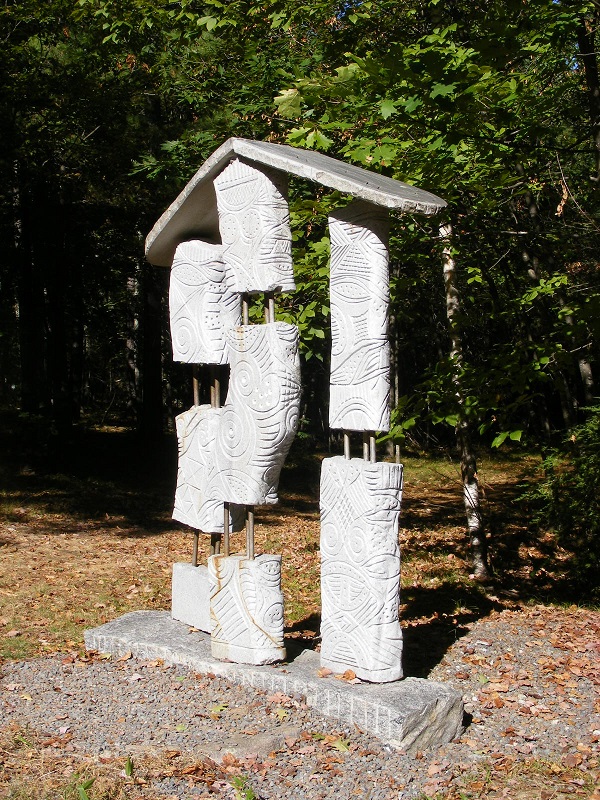
sculpture in white granite
Mbari House by Geoffery Nwogu, one of many sculptures along the trails at the Andres Institute of Art, Brookline NH. 

Traditional school’s out, gyms are shut, businesses are closed, paychecks may or may not be forthcoming, and #stayhome is trending. My walks are a refuge from all that. 

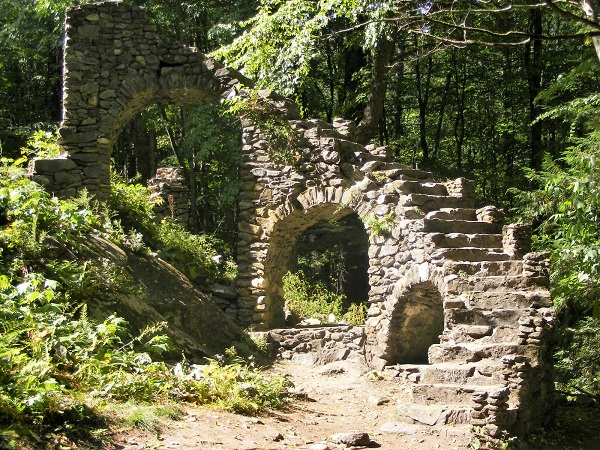
ruins of stone house in a forest
Madame Sherri Forest, Chesterfield NH

Golden Time in New Hampshire

As Octobers go, this one has been a beauty in my corner of New Hampshire. We’re in that annual golden time, post-bugs and pre-ice. Literally golden, too. The trees are glowing.

rail trail in autumn
October on Nashua River Rail Trail. All photos by Ellen Kolb.

 Pulpit Brook Trail, Bedford and Amherst

I hadn’t visited Bedford’s Pulpit Rock conservation area in years. A recent mailing from the Bedford Land Trust advised me that the Pulpit Brook trail from that property now extends into Amherst and the Joppa Hill farm. When I compare a newer map of the Pulpit Rock area to my old map from 1997, it’s striking to see how much the conservation area has been expanded with the cooperation of area landowners. I like seeing a greenway linking towns.

autumn leaves
Mid-October: some leaves are just starting to turn.

Silver Mountain, Lempster

The Forest Society’s Five Hikes in Five Weeks program led me to this unassuming little hill with fine autumn views. The drive in was a little hairy: Lempster Mountain Road is paved and fine, and from there South Road is unpaved and sort-of fine, until it isn’t. The last few tenths of a mile of road before the trailhead feature a single lane with deep ruts. It must be all kinds of fun in mud season. At least it’s dead-flat.

But after a couple of minutes of bouncing along…what’s this? A parking area with decorative stone posts. On a dirt road in Sullivan County, no less.

From the parking area, the woodsy walk up to the open summit of Silver Mountain is easy.

berries on hilltop, autumn in NH
Autumn on Silver Mountain, Lempster NH
Silver Mountain summit cairn NH
Silver Mountain summit cairn; Vermont’s Mt. Ascutney in the distance at right

Kidder Mountain, New Ipswich

Here’s another spot I hadn’t visited in ages, just off the Wapack Trail. I had hiked up to Kidder with my son about fifteen years ago, and I recalled it as another one of those easy hills with great views (like Silver Mountain, come to think of it). I’m sorry I waited so long to come back.

The summit vegetation has grown in over the past few years, but the views to the south and southeast are still satisfying. There’s a great view of the southern Wapack Range from Barrett Mountain to Mt. Watatic.

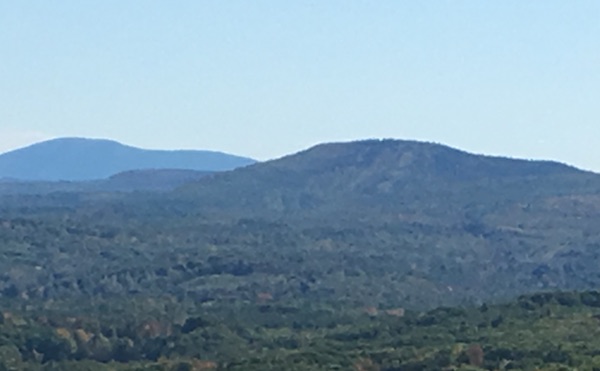
southern Wapack Range
Southern Wapack Range seen from Kidder Mountain, New Ipswich NH

On my recent visit, I shared the summit with a young family. One of the children was a boy, maybe five years old. He surveyed the Wapack Range, and announced excitedly, “I see a volcano!” His dad took the news calmly. The boy wanted a livelier response. “I see lava!” At that point, I thought okay, I’ve got to see what this is about.

Mt. Watatic
At right: Mt. Watatic, faintly marked with old ski trails that spark the imagination.

I moved a little closer to see what the boy was pointing at. It was little Mt. Watatic just across the border in Massachusetts. It had a ski area long ago, and there are still faintly-discernible ski trails. To a five-year-old, those old trails looked like lava flows. I hope I never forget the look on that little boy’s face as he watched Mt. Watatic expectantly, hoping against hope that it would blow its top and show those Monadnocks who’s boss.

Sometimes the best part of a hike isn’t the hike.

Coos County summer hikes

Job responsibilities prevented a backpacking trip for me this season. I settled for four days of dayhikes in Pittsburg, way north in Coos County, New Hampshire. (CO-ahhs, if you please, in case you’re new here. Welcome.)

Conditions: upper 80s, high humidity, overcast, with a low cloud ceiling that cut off views of nearly every peak in the area. On the other hand, I was there on quiet weekdays, and I had the solitude I craved on every road and trail.

Magalloway from Ramblewood
Mount Magalloway (in cloud) and First Connecticut Lake. All photos in this post by Ellen Kolb.

Cohos Trail Segments

Covell Mountain really does not want to yield a trail this summer. There were signs of storm damage and logging. The mud made me glad I had shoes with a moisture-resistant lining. Grasses were growing high despite obvious efforts by trail adopters to keep them in check. Blazes were clear and plentiful, though, and I know I can thank those same trail volunteers for that.

There was a newly-fallen spruce across the trail, not far from a junction with a path marked Cattail Trail. The spruce refused to give way to the little knife I carried. All I got for my pains was a sappy blade.

Perhaps on a clearer and cooler day, I’d have kept going past Covell to Prospect Mountain, where on another trip I enjoyed a spectacular vista. This was not a week for great views, I thought, so I contented myself with an up-and-back hike on Covell.

As I returned to my car parked at the Ramblewood campground, I caught sight of Mt. Magalloway and a sliver of First Connecticut Lake. The summit was obscured by cloud and the lake reflected the gray sky: a striking monochrome landscape offered up by Covell Mountain, as if to thank me for putting up with its messy trail.

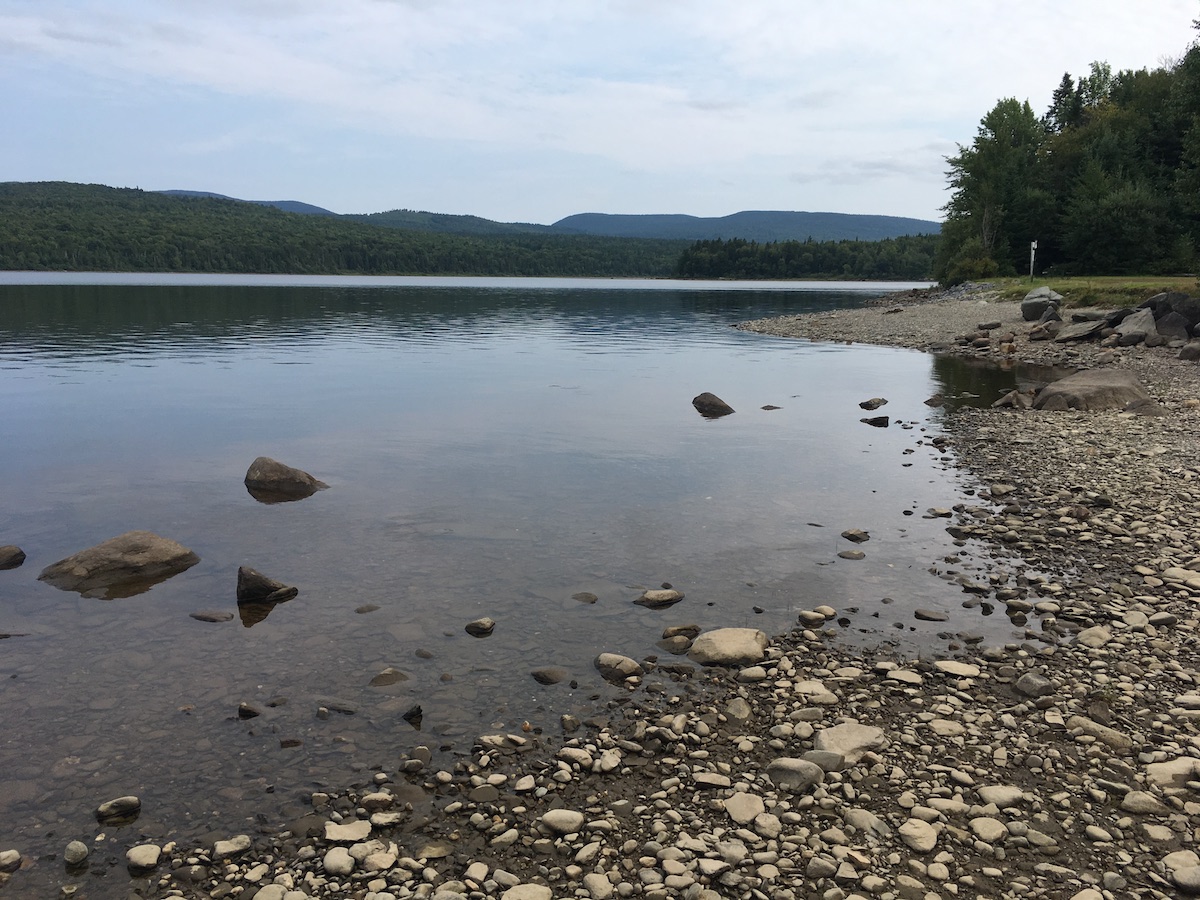
2nd Lake d
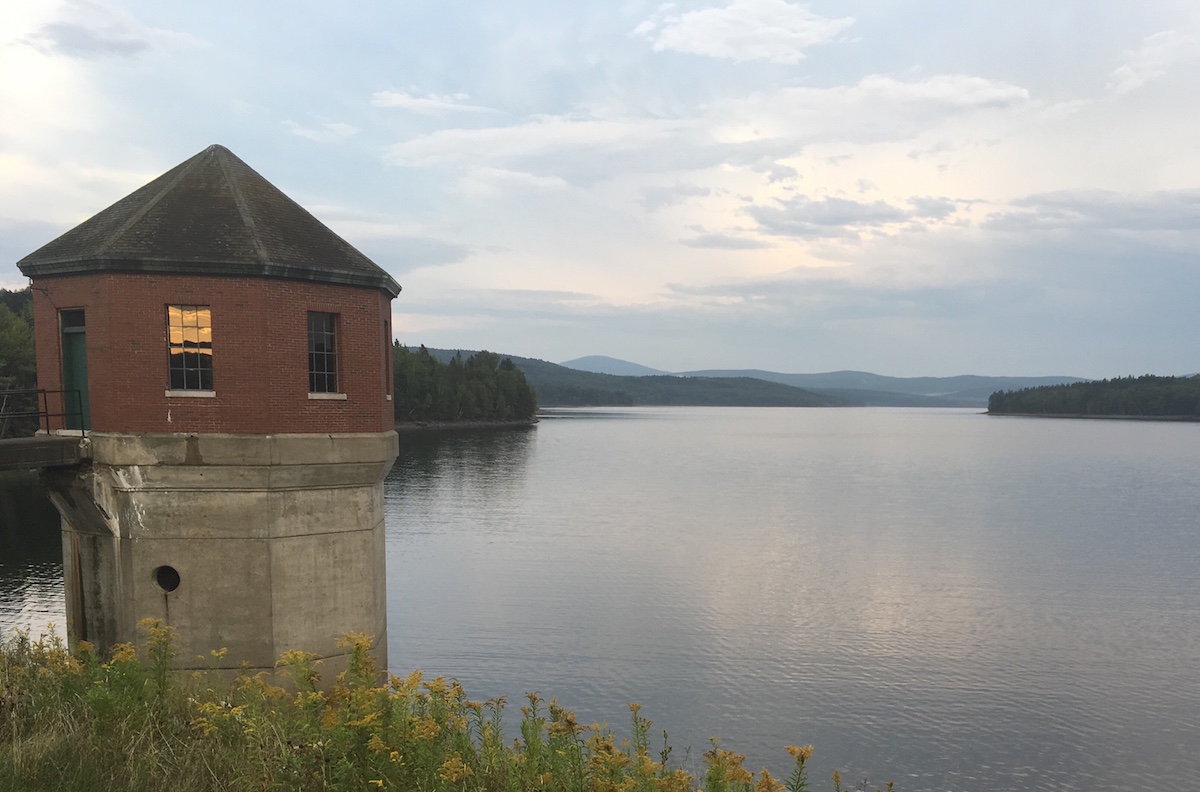
Second Connecticut Lake, at a low late-summer level.

Peaceful Second Connecticut Lake never disappoints, however short the visit. This time, I parked at the dam alongside U.S. 3 and followed the Cohos Trail north.

The trail soon intersected Idlewilde Road, and I turned for the five-minute detour to the Idlewilde boat ramp. On a hazy late-summer afternoon, I stood at the ramp on the lake’s shore all by myself, with a loon’s call the only sound I could hear.

Back on the trail, I took up the Chaput segment. It’s named for a couple I’ve never met who are famous to Cohos Trail veterans for their years of trail work. The segment is parallel to and very close to U.S. 3, but it gets hikers off the pavement. I’m a fan. I hiked the northern section of the Cohos Trail in 2009, and at that time the last ten miles of trail to the Canadian border were on the highway. Thanks to the efforts of many volunteers, that’s no longer the case.

Lainie's Lair
“Lainie’s Lair,” on the Cohos Trail.

Along the Chaput segment, I found the little rocky overhang nicknamed Lainie’s Lair. That’s a fun tribute to another legendary Cohos Trail volunteer. Lainie brought me with her for a memorable day of trail work during my 2009 hike. I had a lot of enthusiasm for the task, but zero skill. Lainie patiently coached me on things like how to use tools without hurting anyone and how not to freak out at the sight of bear scat. She could have accomplished a lot more that day in 2009 without me, but she was happy to be my guide. Nine years later, I smiled at the whimsical salute to her at the “lair.”

Sophie’s Lane is part of snowmobile corridor #5, and the Cohos Trail follows it beginning just south of Deer Mountain State Park. After being in the woods on a hot day, Sophie’s Lane was a relief. It was wide and open enough to catch a breeze that kept insects at bay. The lane leads to a spur to the site of an old fire tower on Deer Mountain (no cab or platform remains), which is a side trip I didn’t take.

I liked the short spur to Moose Flowage, which is part of the Connecticut River south of Third Lake. It was a good spot for a break and a snack. It was a tempting place for a campsite as well, but signs sternly warned against any such notion. Deer Mountain state park’s campground, accessible from U.S. 3, is just across the Flowage.

snowmobile trail information kiosk, Pittsburg NH
Sophie’s Lane trail kiosk

The lane gradually narrowed the further north I walked. I stopped well short of the Canadian border, avoiding a walk through a long weedy stretch of trail. I passed a clearing with one boulder covered in street art. That jarred me. That painted rock somehow bothered me more than the relatively new cell tower at the north end of First Lake. It poked a big hole in the sense of isolation I expected in August on a snowmobile trail three miles from Quebec.

What I didn’t see along the way – not on Sophie’s Lane, and not anywhere else – was a moose. No bear or deer, either. I saw moose tracks in one muddy spot, but as for the beasts themselves, nada. Perhaps the heat kept them in hiding. Maybe I’m such a noisy hiker that I scare off everything larger than a mosquito. My presence didn’t bother the birds, though. It was a good week for seeing heron, hawks, and turkeys.

Pittsburg: the Village and Happy Corner

Broadband has come to Pittsburg, or at least parts of it. I stayed in the village – downtown Pittsburg, more or less – in a comfortable little cabin with WiFi and cell service.

The snowmobile crowds are a few months away, people are buttoning up their camps for the season, and the summertime ATV vacationers have mostly returned to work and school. The town roads were thus quiet and inviting during my recent visit. As always in Pittsburg, the people I encountered were friendly and hospitable, ready to answer my questions and point me to interesting places.

A three-mile loop walk from my cabin at day’s end took me to Murphy Dam, Lake Francis, and Cedar Stream Road. A tranquil route, from start to finish. Had I moved east on Cedar Stream Road rather than west towards town, I’d have picked up a Cohos Trail segment leading to the east side of Lake Francis.

Lake Francis Murphy Dam
Lake Francis seen from Murphy Dam

Six miles north of the village, the crossroads known as Happy Corner makes a good base for a few Cohos Trail dayhikes and for exploration of town roads. I loved rambling with no schedule and no fixed route.

Road Tripping

I only get up this way once a year or so, and I try to make the most of the long drive. I drove a circuitous route on the way north in order to photograph a slew of North Country historical markers. Interesting sites, interesting history!

Cog marker
On a cloudy morning, the Cog Railway track seemed to disappear into Mount Washington.
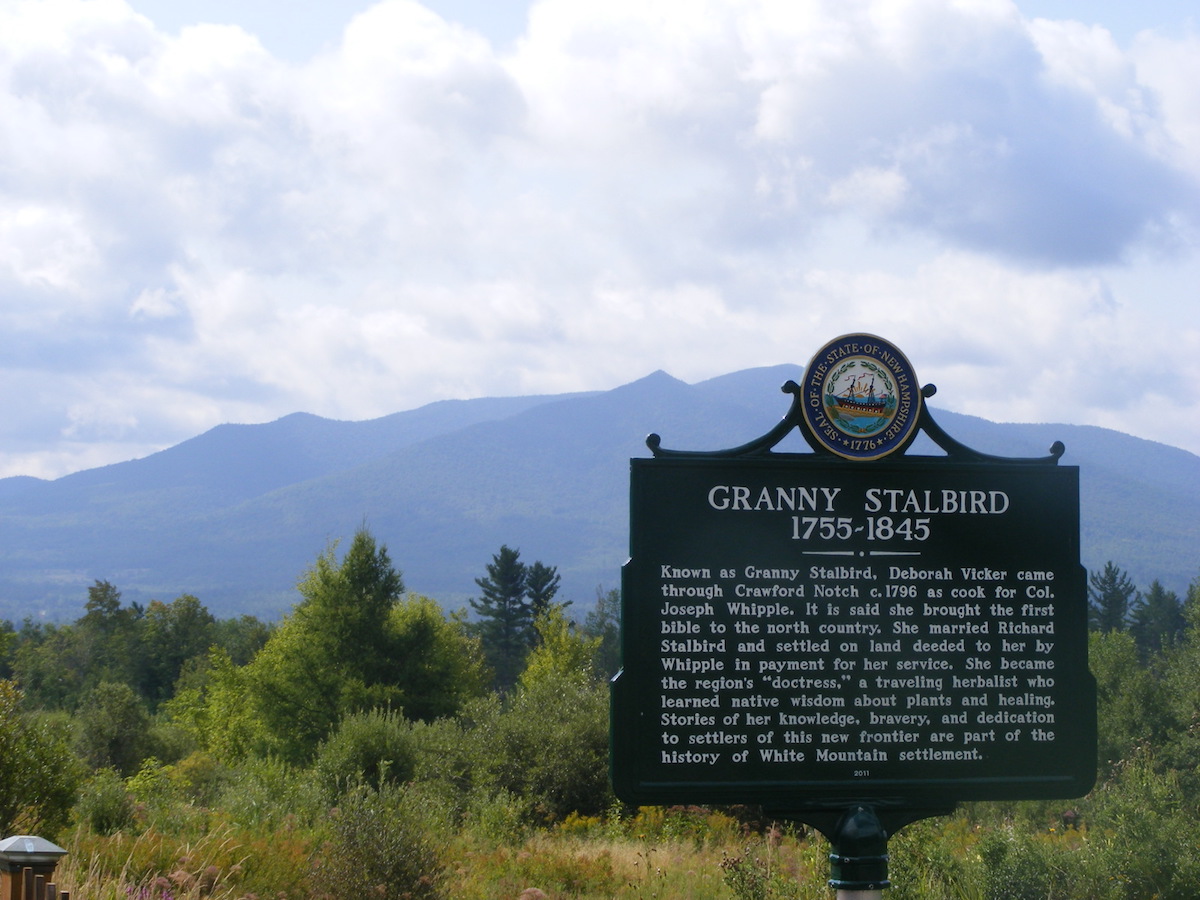
Stalbird marker with Mt Martha
That’s Cherry Mountain behind the Granny Stalbird marker in Jefferson.
City Trees Built marker
The city of Berlin on the Androscoggin River boasts four markers, each featuring a different aspect of the city’s heritage.

A short stop at Winant Park, Concord NH

I love discoveries that leave me wondering how did I not find this place sooner: this week, it was Winant Park in Concord, near St. Paul’s School. I’d seen it listed on the city’s map of area trails, but had never managed to find time for a visit until recently.

Piles of snow edged the parking lot and some stretches of trail on a late February day, but a warm week had melted a great deal of snow and left the trails muddy. There were a few other cars in the trailhead parking lot, which is easy to find on Fisk Road just off Pleasant Street.

The park is wooded, with a pair of vistas I enjoyed: a view featuring the State House dome (a view obviously preserved with diligent tree-trimming) and a view of the hills and low mountains to the south and southwest. A kiosk at the trailhead and informational signs along the trails offer information about the park’s history. The trail network is simple and well-marked.

Winant Park SSW overlook
View from a hill in Winant Park (l-r): the Lyndeborough hills, Crotched Mountain, and Monadnock peeking out from behind Crotched’s ski area.

This is an urban park, with “urban” being relative; we’re talking Concord here, not Boston. It’s not a destination park like Monadnock or Pawtuckaway. It’s an easy stop for anyone in or near Concord, though, and it’s a fine place for a quiet walk in the woods. Make a point of finding that southwestern vista, which might not be so visible once the trees leaf out.

In kindness to the trails and their maintainers, I’ll wait until mud season is over before I pay another visit here. But I will be back.

Cool and Shady: Falls in the River, Cohos Trail

Another trip to northern New Hampshire for me meant another walk to one of my favorite spots on the Cohos Trail, the Falls in the River. No trip to Pittsburg on a 90-degree day would be complete without it. From the parking area by the Second Connecticut Lake Dam, a half-hour southbound walk through the woods on the blazed Cohos Trail brought me to the Falls. Soon I was refreshed in every way.

A few years ago, my husband and I were among the volunteers who put the finishing touches on this segment of the CT before it was officially dedicated. Others had done the hard work. It has since become one of the CT’s most popular dayhike areas.

Rushing water over boulders in a riverbed, with shrubs growing on the shore
Falls in the River, Pittsburg NH, June. Photos by Ellen Kolb.
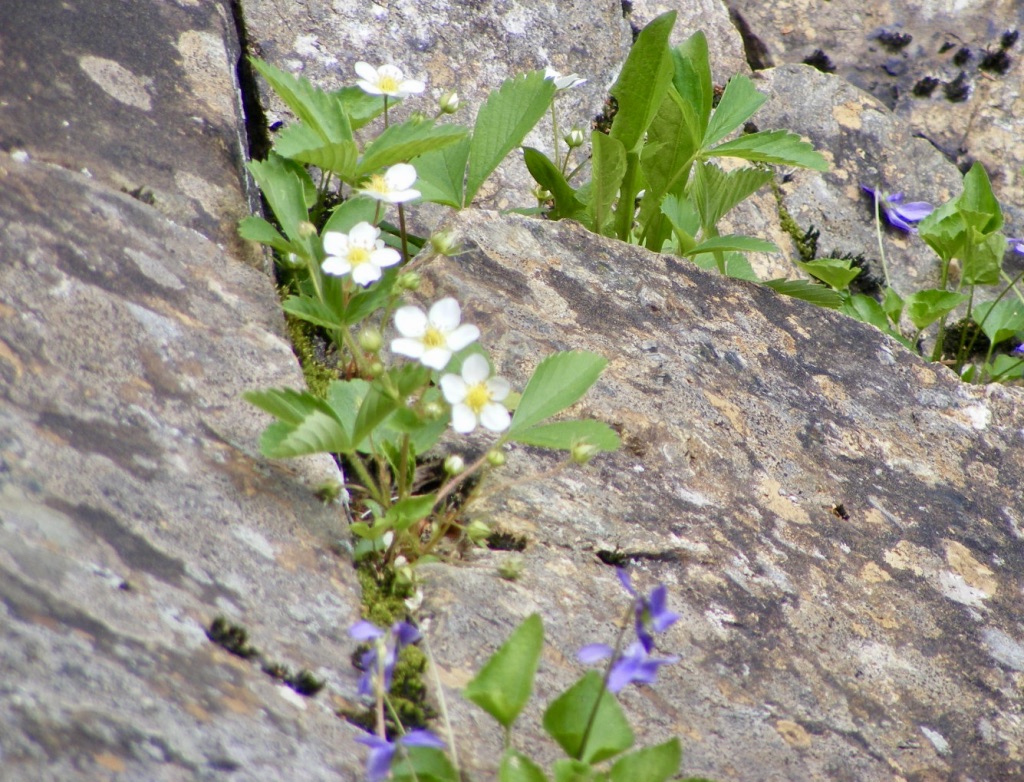
small wildflowers growing from a crack in a boulder
Cracks in the granite give tiny blossoms a home.
Lake surrounded by evergreen forest
A peek at Second Connecticut Lake from the parking lot by the dam. 

The trail in this area manages to feel remote even when it’s squeezed between U.S. 3 and the Connecticut River. Trees conceal the highway and muffle the sound of vehicles.

I saw no moose. I figured the hot weather would keep them from being out on the roadside at midday, but I thought for sure I’d see one in the woods. I saw only their prints in the mud.

Learn more about the Cohos Trail at cohostrail.org and the Friends of the Cohos Trail Facebook group. Links updated, 2026.