Sunset walk, with turkeys

I seldom take sunset walks these days. Fresh into Daylight Savings Time, though, I find myself with daylight to work with even after I’m through with the dinner dishes. The lingering light lured me outside yesterday, long enough for a round-the-block stroll. I was well-rewarded: I saw and heard the local turkeys as they called it a day.

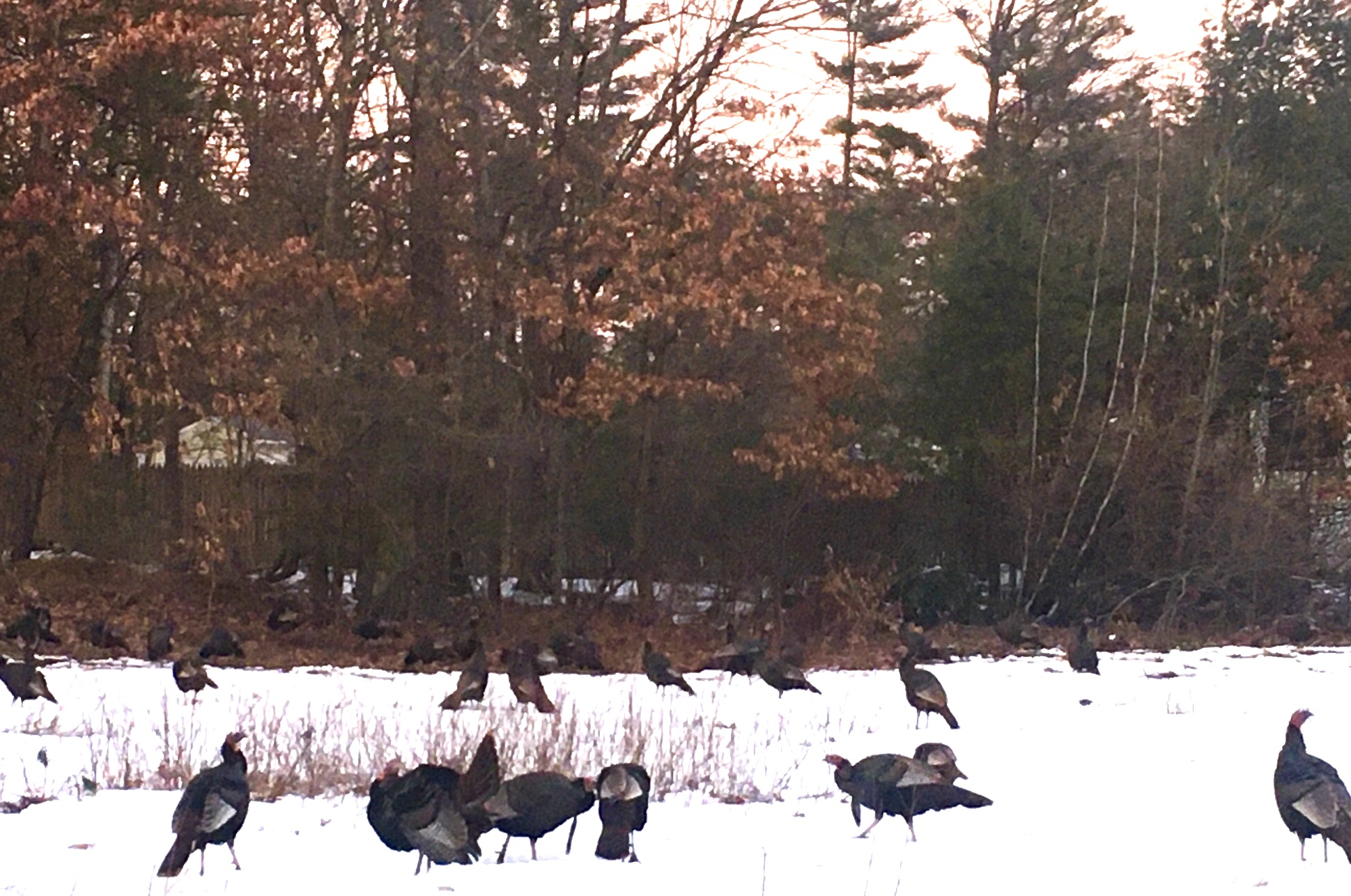
We share our suburban development with a flock of wild turkeys. My neighbors and I are accustomed to seeing them a few at a time in our yards throughout the year, patiently gobbling up spilled seed beneath bird feeders or checking out freshly-turned soil in our gardens. The flock has grown over the past several years, and I counted 57 turkeys a few weeks ago, pecking and scratching under nearby power lines for whatever food they could find. They’re habituated to us, but still wild.

Wild turkeys flocking together, late winter. Ellen Kolb photo.

I’m used to hearing gobbling and clucking, along with the occasional thumping whoosh as a turkey takes ungainly flight, usually at just the right altitude to match the grille of an oncoming car. On my recent sunset walk, I heard that whoosh, then another and another. Soon I came upon the cleared space under the power lines, and there they were: dozens of turkeys, taking flight one at a time, not to torment motorists but to head into the nearby pines to roost.

I’d never seen a flock at sunset. I stood fascinated, watching them ascend to their chosen spots. There were a few kerfuffles as some of the roosting birds objected to having their space invaded by later arrivals, but there was ample room in the stand of trees for all of them. Soon the clucking subsided to softer sounds, and the whooshes came to an end.

The timing was none of my doing. I just got lucky. Pretty good stuff, for a spur-of-the-moment walk.

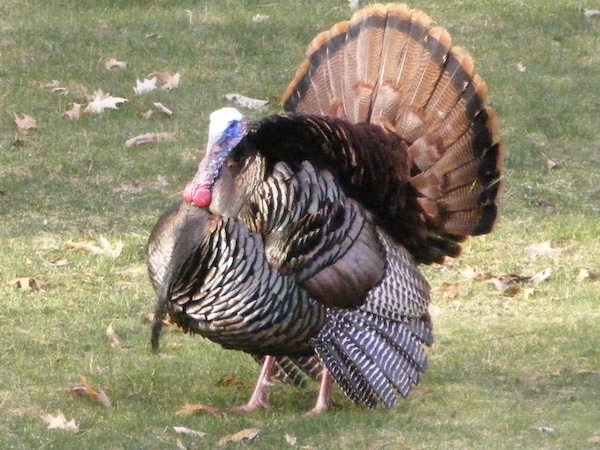
male wild turkey displaying feathers
Male wild turkey, posing for his portrait. Ellen Kolb photo.

According to New Hampshire Fish and Game, wild turkeys were successfully re-introduced into New Hampshire in the 1970s, after more than a hundred years of absence due to habitat loss and overhunting. Since then, the turkeys have been thriving. Too thriving, it sometimes seems: I think every driver in the state has at one time or another had to stop for a bunch of turkeys crossing a road, always one bird at a time, moving at an infuriatingly leisurely pace.

I’ve grown a bit more patient with the big fowls as they’ve moved into the neighborhood. I’ve seen them throughout the year, courting and squabbling and caring for their young. Without meaning to, I’ve picked up a bit about the rhythm of their lives. They’re remarkable, even if they do act as though they own the roads.

Updated 2026 to revise web link.

Teamwork makes solo walks possible

I was on the Nashua River Rail Trail for a few miles this weekend. I couldn’t help noticing freshly-cut logs and branches along both sides, thanks to volunteers I’ll probably never meet. Breezes and recent heavy wet snow had brought down trees all over the place. On the northernmost stretch of NRRT, the mess is cleared. All I had to toss aside were a few small branches.

Nashua River Rail Trail: winter winds brought down a tree, and volunteers cleared away the mess. Fence-mending will wait.

Not so upstate at one of New Hampshire’s largest ski areas which I recently visited. It’s one of the few ski areas in the state with a decent system of trails for Nordic skiers and snowshoers. While the resort’s management is understandably focused on the downhill ski trade (that’s where the money is), there’s not enough staff to keep the snowshoe/fat bike trails cleared, at least not yet this season.

I’ve kept an eye on websites reporting on New Hampshire rail trail conditions. Many of the rail trails are much longer than NRRT and have that much more of a mess to clean up. Enter the snowmobile clubs: I’m aware of two in particular in the southwestern part of the state that put out calls for volunteers for workdays this weekend. I’m sure that snowmobile clubs all over the state are doing the same thing, as pretty much every region got hit by storms over the couple of weeks.

Those clubs are doing work that will make walks much easier for me year-round, not just in winter. Grooming snow, clearing deadfall, and mowing grass take time and equipment and volunteers. I like walking alone, but some of the most enjoyable trails I know wouldn’t be accessible or pleasant without the work of many people. My solo walks benefit from teamwork.

Want to say thanks to the snowmobile clubs? Send a donation, even if you’re not a member. Include a note saying that you’re a grateful hiker. The New Hampshire State Parks website provides a list of clubs, and you can look up a club’s social media accounts (usually updated much more frequently than websites) to find contact information and to keep track of opportunities to volunteer for trail work.

My winter walks thus far have mostly been close to home, in neighborhoods and municipal parks. Those routes could use post-storm help, too. Your town’s parks and rec department or conservation commission might put out a call for volunteers on specific cleanup projects. Be on the lookout for such announcements.

And if you happen to come across some folks doing trail maintenance while you’re out and about, stop to say thanks.


Hike Safe card: not just for mountain hikers

For my New Hampshire readers, here’s a plea from me: if you haven’t purchased a Hike Safe card, please do so now. Even if you’re sure you’ll never need to be rescued, buy one anyway. It will be a small way of supporting the state’s Search and Rescue fund. Sadly, demands on the fund never let up.

Take out a credit card, go online to the New Hampshire Fish and Game’s Hike Safe page, and plunk down $25 for a virtual card covering an individual, $35 for a family. If a Hike Safe cardholder needs to be rescued in the course of an outdoor activity, she or he will not in most cases be assessed for the cost of the rescue. Just get the card. Don’t wait.


I write this as I hear news about a hiker who perished upstate while attempting a solo hike on a mountain ridge in winter weather. A few weeks ago, another hiker lost her life in the same area. Rescue attempts, which became recovery missions, involved professional conservation officers from New Hampshire Fish and Game plus many volunteers.

Those same volunteers and first responders would come out even if the trail were less challenging. They don’t write off any of us. Missing hikers, once reported overdue by family or friends, spark a search-and-rescue mission.

I know from experience that hikes can go awry even in good weather on heavily-traveled trails. (A particularly embarrassing day on Monadnock comes to mind.) While I haven’t yet inspired any rescue missions, I’m uncomfortably aware that this could change anytime. I carry simple essentials even for short hikes, but even so, bad stuff happens now and then.

Ninety percent of my trail miles are on flat trails within an hour of my home. I buy a Hike Safe card every year anyway. It’s cheap insurance against being assessed some hefty costs arising from my own negligence. More importantly, the card lets me as a hiker contribute to the readiness of search-and-rescue teams.

Hunters, anglers, and anyone registering a boat, OHRV, or snowmobile already contribute to the Search and Rescue fund as part of their license and registration fees. Hikers don’t need a license. We can pull our weight, so to speak, by purchasing the Hike Safe card.

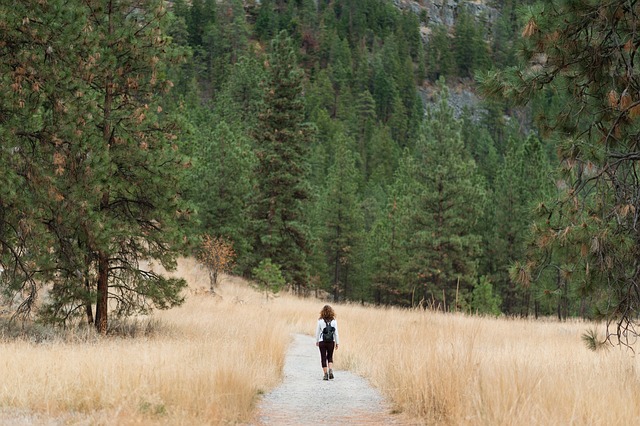
Image by yinet gomez from Pixabay

A pair of enduring favorites: Mt. Kearsarge and Oak Hill

The Granite State Walker blog is now sixteen years old! This modest landmark prompted me to look back and see which posts have drawn the most viewers – and I hope inspired as many hikes – during that time.

Two destinations finished way out in front: Mount Kearsarge with its trailheads in Warner and Wilmot, and Oak Hill in Concord. Each has prompted several posts from me, and even the older posts keep finding an audience.

I’m not surprised. Each of those locations has a fire tower, which can be an irresistible draw. Each one offers multiple trails. Easy access is another advantage: the south side of Kearsarge, via Rollins State Park, is only a few minutes’ drive from I-89. Oak Hill is close to I-93, and in fact is only a 12-minute drive from the State House (I checked).

The auto road through Rollins State Park ends at a picnic area a half-mile from the Kearsarge summit, which is a short hike for day trippers. (Don’t be lulled into carelessness by the short distance; plan ahead and wear appropriate footwear.) When the auto road is closed to vehicular traffic, usually November through May, it’s still accessible to pedestrians and bicyclists, and one needn’t get to the summit to find fine views along the way. Winslow State Park on the north side of Kearsarge offers a longer hike.

The Oak Hill trails are managed by the city of Concord, which has a surprising number of parks and trails for a city its size. The trail to the fire tower meanders uphill for about two forested miles to the Concord-Loudon town line. Shorter trails lead to pleasant vistas, including a western prospect that looks out toward – you guessed it – Mt. Kearsarge.

In sixteen years as the Granite State Walker, I haven’t run out of good places to explore south of the White Mountains. New trails are ahead, I know. But it’s good to have some old favorites to which we can return now and then. Kearsarge and Oak Hill are two of the best.

Follow the leaders: McCabe Forest, Antrim NH

I like walking and hiking solo. Peace, quiet, my own pace. But sometimes a guided hike is a good thing. I have a lot to learn about the things I see. One way I try to expand my horizons is by participating in some of the guided hikes offered by the Society for the Protection of New Hampshire Forests, better known as the Forest Society. I recently joined one at the Society’s McCabe Forest in Antrim. (Parking for the property is on the east side of U.S. 202, about a mile north from the center of Antrim.)

The last time I was at McCabe Forest, it was summertime, and the insects were out in force. Now, it’s autumn, the golden time, pre-ice and post-bugs. Forest trails are in style.

The Contoocook River edges the property. The river is lazy and low this time of year, but there’s evidence of how high it can get in periods of heavy rain. I thought about how often I’ve seen the Contoocook during my travels: I’ve hiked along the rail trail in Rindge and Jaffrey that follows the river from its source. I’ve walked the Peterborough Common Path in wintertime with the river beside me. I’ve seen it as I’ve explored Mast State Forest in Concord, just a few miles from where the river flows into the Merrimack.

River and forest, autumn, New Hampshire
Contoocook River, Antrim NH. Photos by Ellen Kolb.

I long ago abandoned the silly notion that if you’ve seen one forest trail, you’ve seen them all. Even a single trail can fascinate me with its changes from one season to the next. Accompanying someone familiar with a property can help me sharpen my powers of observation. How could I walk right by a mahogany-colored mushroom of majestic dimensions? I would have, without a guide. It would have been just a random thing blending in with the fallen leaves.

Fungi on the forest floor, dwarfing the leaves

People living in a house at one edge of the property enjoy a view that many of us might envy, with no sign of where the backyard ends and the Forest Society land begins. The “border,” such as it is, is figuratively afire with a very attractive shrub that is unfortunately an invasive nuisance. Burning bush is an apt name for it, with leaves whose color stands out from everything around them. Originally imported as an ornamental, burning bush has escaped garden plots all over the state and now crowds out native plants. In fact, it’s now a prohibited species in New Hampshire, so don’t try to buy it. In my own town, it’s one of several hard-to-control invasives on our Conservation Commission properties.

Burning bush, a invasive ornamental plant
Burning bush, attractive but invasive

These Forest Society hikes feature informal lessons on natural history, geology, and the people who have lived in the area. (If you’re ever on a Society hike with Dave Anderson, settle in for some good storytelling.) Also, it’s fun to meet people who share an interest in New Hampshire’s natural beauty. Keep the Forest Society in mind if you’re looking for guided-hike ideas. You’re bound to come across something interesting.

Autumn afternoon on Pack Monadnock

As a pedestrian, I like to take advantage of the auto road up Pack Monadnock in New Hampshire’s Miller State Park during off-hours, when the gate is closed to auto traffic. Sometimes I’d just rather reach the summit on smooth pavement instead of using the trails in the woods. I recently made the trip as late afternoon was shading into evening.

Miller State Park auto road (Pack Monadnock), late October. Photos by Ellen Kolb.

The road’s uphill grade gave me a bit of a workout, even at my easy pace. I’m discovering that a pair of trekking poles can be helpful to me no matter how smooth the terrain. My poles and I made it to the picnic area at the summit about 35 minutes after leaving the parking lot, covering a bit under a mile and a half of road with 700 feet of elevation gain.

Mount Monadnock seen from Pack Monadnock

Gold and bronze leaves caught the setting sun and made the woods glow.

The Boston skyline was lost in haze, except for one of the Back Bay skyscrapers situated at just the right angle to reflect the sun’s rays. It was probably the glassy Hancock building, which I know has a different name now – but it will always be the Hancock building to me.

Mount Monadnock – the Grand Monadnock – is only a few miles away. The view of it from the picnic area at the summit of Pack Monadnock is almost clichéd; everyone takes a photo from the same spot. I’m no exception. The colors of the sky vary with the season and the time of day. Sometimes the view is hazy and sometimes it’s crystal clear. However many pictures I’ve taken there, no two are identical.

New Hampshire historical marker number 270, Miller State Park, Pack Monadnock summit

I love finding historical markers on my walks, and there’s a new one atop Pack Monadnock in honor of Miller State Park. Almost all of the New Hampshire markers are placed along state highways, but this one rated a special spot. Route 101 gets you to the park, but you’ll have to drive or hike to the summit to see the marker.

I got to the park too late in the day to join the autumn raptor migration count that takes place on Pack Monadnock daily, sponsored by New Hampshire Audubon and the Harris Center in Hancock. It’s a fascinating event that’s definitely worth checking out if you’re in the area this time of year. Bring the kids!

The park’s $4 admission fee is a bargain. I put my donation in an envelope and dropped it in the iron ranger, which is a donation box visitors can use when there’s no attendant on duty. For visits during the park’s regular hours, I advise checking the New Hampshire State Parks website first; reservations might be advisable on busy days. The park entrance to the auto road is located on NH Route 101 in Peterborough.

Several of the state parks have auto roads to featured vistas, and they each make for a pleasant drive. My favorite way to enjoy those roads, though, is on foot in the early morning or late afternoon, when the gate is closed and there are no cars around. Autumn with its moderate weather is prime time for a visit.