Where NH rail trails meet history

The more I hike around the Granite State, the more I become aware of the pieces of history visible along the way. There are stories everywhere, told in many ways: markers, signs, cellar holes, even concrete footings from long-gone towers and cabins. The recent dedication of a historical marker not far from my home sparked this post, which I wrote for nhrtc.org, the website of the New Hampshire Rail Trails Coalition.

You’ll be well rewarded as you travel along New Hampshire’s rail trails if you keep your eyes open for reminders of Granite State history and heritage. You’ll find informative markers, plaques, and signs celebrating people and events. Among the newest is the Black Heritage Trail marker honoring William Hobdy, mounted on the Derry Rail Trail just south of Broadway (NH Route 102).
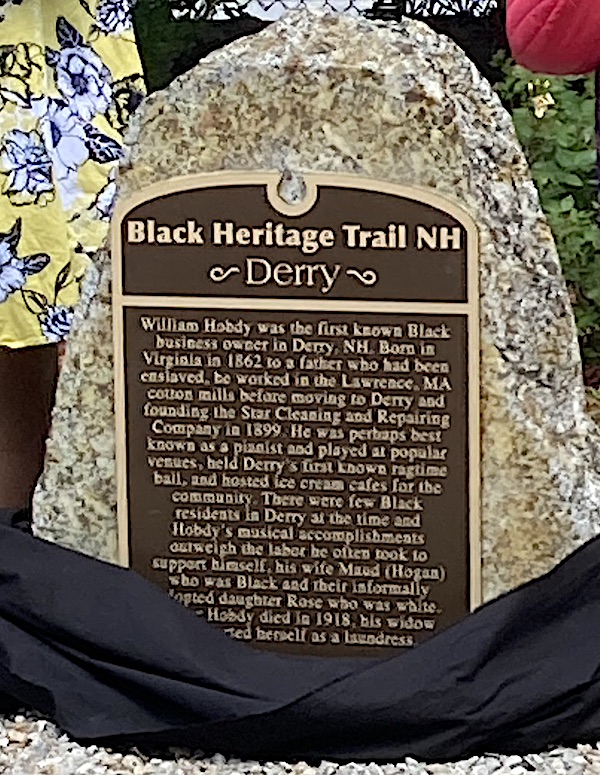
Historical marker from Black Heritage Trail in New Hampshire honoring William Hobdy
On the Black Heritage Trail in New Hampshire: a tribute to William Hobdy, businessman and entertainer. Photo by Ellen Kolb

The dedication of the Hobdy marker was a community-wide event drawing a crowd to central Derry. William Hobdy lived in town in the early 20th century and became owner of a small business. His music brought him his greatest renown, as his ragtime piano skills graced local venues. Now, the marker relating his story is a prominent feature on the Derry Rail Trail in the town center.

On the same trail, keep an eye out for artwork framing a poem by Robert Frost, who once taught at nearby Pinkerton Academy before earning worldwide fame for his poetry.

Another Black Heritage Trail marker is at Potter Place in Andover, where a restored depot is a scenic highlight along the popular Northern Rail Trail. Andover resident Richard Potter was a 19th-century entertainer who gained nationwide fame as a ventriloquist, magician, and humorist, but his story didn’t end there. The marker honoring Potter can inspire you to learn more about him and his time.

Canobie Lake Station marker along the Salem NH bike-pad trail. Ellen Kolb photo.

Thanks to the enthusiasm of rail trail fans in conjunction with local historical societies, some trails celebrate a heritage of passenger rail to popular parks and bygone resorts. Kiosks in the towns of Troy and New Boston display reproductions of  train schedules from the days when Boston residents would come to New Hampshire via train for vacations and day trips. In Salem on the Bike-Ped trail, a marker recalls train service to Canobie Lake and Rockingham Park. 

Sometimes, a sign will spotlight a feature of the trail itself. Watch for an informational sign along the Sugar River Trail in Newport about the unusual Pier covered bridge, built tall enough to accommodate the trains that used to ply the route. Motorists on nearby roads can’t see the bridge, but trail users get to travel right through it.

These clues to local history add something special to an excursion on rail trails. Every trip can reveal something new.

Finishing the NH Rail Trail Challenge: some patch-y thoughts

There’s a colorful new piece in my trail-memento shadow box: the patch noting completion of the New Hampshire Rail Trails Challenge. Over the past few years I’ve walked, and occasionally biked, on every rail trail in the state. That’s hundreds of miles, especially considering that I usually hike alone and don’t have a shuttle to get me back to my starting point. I’ve seen everything coming and going.

I loved this project. It’s open to anyone, with details available at nhrtc.org. Check it out, and you’re bound to discover trails you never knew about. Even a single region’s trails could keep a walker busy all year.

This is the project that got me involved with the New Hampshire Rail Trail Coalition. I had the privilege of serving on the NHRTC board for three years. In that time, I met some fine people and got an education in trail development and maintenance. It all started with a list of trails and the dangerous thought “hmmm…I could do that.”

Favorites

Presidential Rail Trail, Gorham-Whitefield. I love this one for its views in Pondicherry Wildlife Refuge, not to mention the views of the Presidential Range and Cherry Mountain. This is far from local for me, but I’ve found ways to get up there every year. Maybe I’d get bored with it if I saw it more often. Hmmmm…no. I’d love it anyway.

Nashua River Rail Trail. This is my home trail, so to speak. I know every bit of it from its mile in Nashua, New Hampshire all the way to its southern end in Ayer, Massachusetts. I first rode it the week of its dedication as a rail trail a couple of decades ago. I must have been there upwards of 200 times since then, observing every season’s changes. It’s justifiably popular. The pavement has its figurative ups and downs, but the recent reconstruction on some Massachusetts segments will keep this trail going for many years to come. And hooray for the city of Nashua, which now keeps the big parking lot at the north end of the trail on Gilson Road plowed in winter.

Rockingham Recreational Trail, Manchester-Newfields. The section heading east from Lake Massabesic at the Manchester/Auburn line is a favorite of mine for a quick two or three midday miles after appointments in Manchester. I avoid it during mud season, but the rest of the year makes up for that. The trail is well-traveled near the lake and becomes much quieter the further east I go. It’s close to Route 101, but the trees lining the trail muffle much of the traffic noise.

One-offs

These are a few of the trails I visited only once. Perhaps I’ll be able to return to them another time.

Lilac City Greenway, Rochester. A business trip to Rochester a couple of years ago gave me a chance to walk along this greenway alongside busy Route 125. In town, it looks like a sidewalk rather than an abandoned rail line. Its landscaping and public art make it a cheery feature.

Sugar River Rail Trail, Newport. This one’s up in Sullivan County, another out-of-the-way place for me. I treasure the memory of the day I spent walking nine-plus miles on this little gem. It’s open to OHRVs, which sometimes creates issues for slow trail users like me, but there were no problems during my midweek visit. It’s a shady trail with several interesting bridges along the way. I benefited from a very reasonably-priced shuttle ride on a Southwestern Community Services bus between Newport and Claremont.

Cotton Valley Rail Trail, Wolfeboro-Wakefield. I visited this one the day a local rail car club had an open house. The unique trail has rails in place for little rail motor cars – interesting in themselves – with the hardpack walking/biking path between the rails.

Lilac City Greenway in Rochester, NH
Lilac City Greenway, Rochester NH. Photo by Ellen Kolb.

I found hiker-friendly towns that I never would have visited if I hadn’t been on a mission to explore every trail. When echoes of Covid restrictions were still in the air, I stopped in Lisbon on the Ammonoosuc trail and found cheerful hospitality. While heading for the Warren rail trail, a driver from a hostel catering to Appalachian Trail hikers agreed to give me a shuttle ride that saved me two hours of walking. (Best five bucks I spent all that week.) The folks at the general store in Danbury along the Northern Rail Trail took one look at my sweaty face, halfway through a 15-mile day, and showed me first to the restroom and then to the cold drinks. I came across such kindnesses all over the state.

You can search this blog for many rail trail posts I made during the Challenge. I hope you’ll take the Challenge yourself. If that’s too big a project to tackle, explore one or two of the trails near you. May your adventures be as rewarding as mine.

All photos by Ellen Kolb.

Close to home, a rainy June

Only last year, we were concerned about drought in New Hampshire. I loved the dry trails throughout summer and fall, but then there was an uneasy November afternoon when a fire behind my house crept through dry duff and brush up to the edge of my yard. (My town’s firefighters did a fine job that day, which is pretty much what they do all the time.)

I’m not anticipating any such excitement this year, at least not in early summer. June has brought rain and lots of it. Maintenance of unpaved trails has been a challenge. Trailside vegetation is growing lushly in defiance of mowers and weed-whackers. My supplies of permethrin and DEET will need replenishing before the season’s out, since pests like ticks and mosquitoes love this sort of environment. And you know what? I’m fine with all of that.

Mountain laurel and sheep laurel are having a magnificent year. Even the buds were beautiful, giving me a week’s notice of the bounty to come.

Close-up of mountain laurel shrub with white blossoms and flower buds.
Mountain laurel, in bud and bloom. Photos by Ellen Kolb/Granite State Walker. This and other photos on the site may be reproduced unedited with attribution.

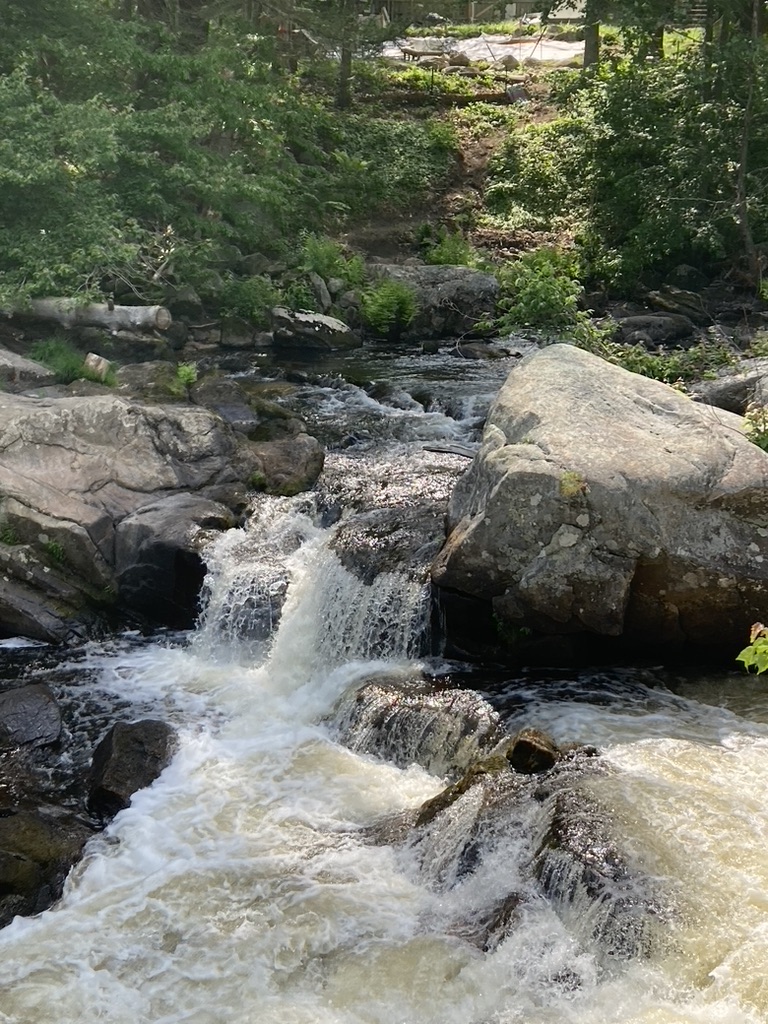
The Souhegan River sure looks good after last year’s low levels. It has stayed within its banks so far. I love being able to hear the river as I walk through my neighborhood! Last year, it made barely a sound as flowed by slowly.

River flowing over rocks, creating small waterfalls
Falls on the Souhegan River, southern NH, June.

Several factors have kept me close to home lately, but I’m enjoying plenty of good walks. I went back to the Andres Institute of Art in Brookline to see what was new on the trails. This unique venue is set up on what was once a very tiny ski area. What used to be ski trails are now walking trails, with sculptures around every turn. New sculptures are installed every year, created by a variety of artists from all over the world. There’s no visitor’s center, but checking the website at andresinstitute.org will help orient the first-time guest. [Update, 2026: AIA now has a visitor center, including a gallery and special programs such as concerts. See the AIA website for most current information.] One of my favorite places on the site is at the modest summit. “Phoenix” by Janis Karlovs of Latvia adorns the view to the west.

Outdoor sculpture titled "Phoenix" on a New Hampshire hill with a ridge of hills in the distance.
At the Andres Institute of Art in Brookline NH, sculptor Janis Karlov’s “Phoenix” seems to point to the Wapack Range in the distance. Note the rain clouds that characterized this rainy June.

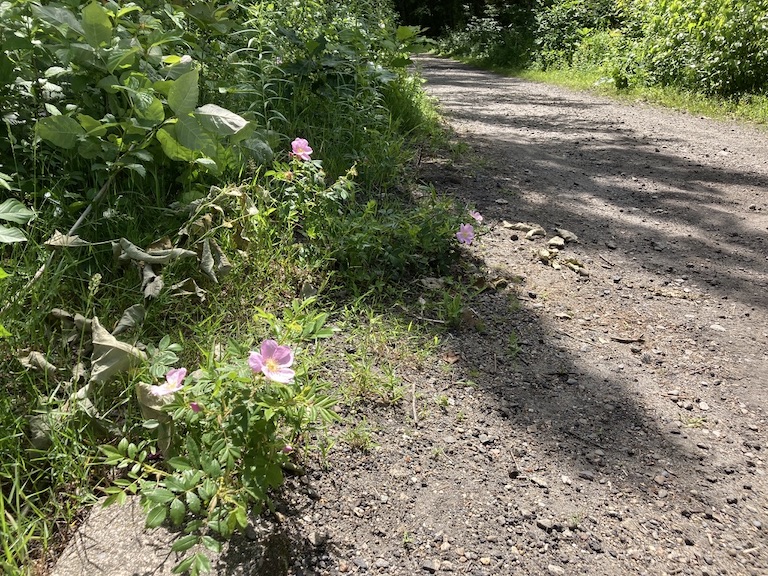
Rain has left the Rockingham Recreational Trail in Auburn soft but not too muddy. The walk eastward from the Lake Massabesic parking lot is one of the best quick lunchtime getaways that southern New Hampshire has to offer. Midweek is ideal. On the edge of New Hampshire’s largest city, sometimes within sight of busy route 101, the trail is a place of quiet refreshment for me. Wild roses were blooming as I walked through recently. I caught the fragrance before I saw the blossoms.

Unpaved rail trail in New Hampshire with wild roses growing along the edge.
Along the Rockingham Recreational Trail in Auburn NH, you’ll catch the fragrance of trailside roses before you see them.

That’s not too bad for a rainy June. I could stand a little more sunshine, but summer is young. Clearer days are ahead.

Cusp of spring along the Merrimack River

My favorite garden center opened for the season yesterday. I picked up one pot each of forced narcissus and hyacinths to put in my front window. No reason, really, except that I want something colorful to look at while the hickory and elm trees outside are still looking drab.

A few more weeks and the drab of winter will be past. Buds are swelling. I walked in Concord today on a trail along the Merrimack River. Around me were bare shrubs, bare trees, and fields of corn stubble. But something further away caught my eye: an island in the middle of the meandering river, with trees adorned with cloud-like pale-red streaks. Maples, of course, flowering earlier than all the other trees. Delightful.

Early April, Merrimack River: looks like spring is coaxing the maples along. Ellen Kolb photo.

The trail was in good shape, with very little mud. That’s not the case everywhere in southern New Hampshire, and mud season makes it challenging for me to pick good places to walk. The bugs aren’t out in force yet, though, which is a plus.

Soon I won’t have to look past my yard for flowering trees and unfolding leaves. That means my spring allergies will soon flare up. Worth it, though.

For now, I like being on the cusp of spring. The tom turkeys in my neighborhood are mightily displaying their plumage in an attempt to impress the hens. My neighbor on the sunnier side of the street is tending to the gorgeous little patch of crocuses blooming in her yard. The herons are back at their rookery. And of course the peepers are out now – the tiny tree frogs whose springtime call sounds like a chorus of little bells.

Sunset walk, with turkeys

I seldom take sunset walks these days. Fresh into Daylight Savings Time, though, I find myself with daylight to work with even after I’m through with the dinner dishes. The lingering light lured me outside yesterday, long enough for a round-the-block stroll. I was well-rewarded: I saw and heard the local turkeys as they called it a day.

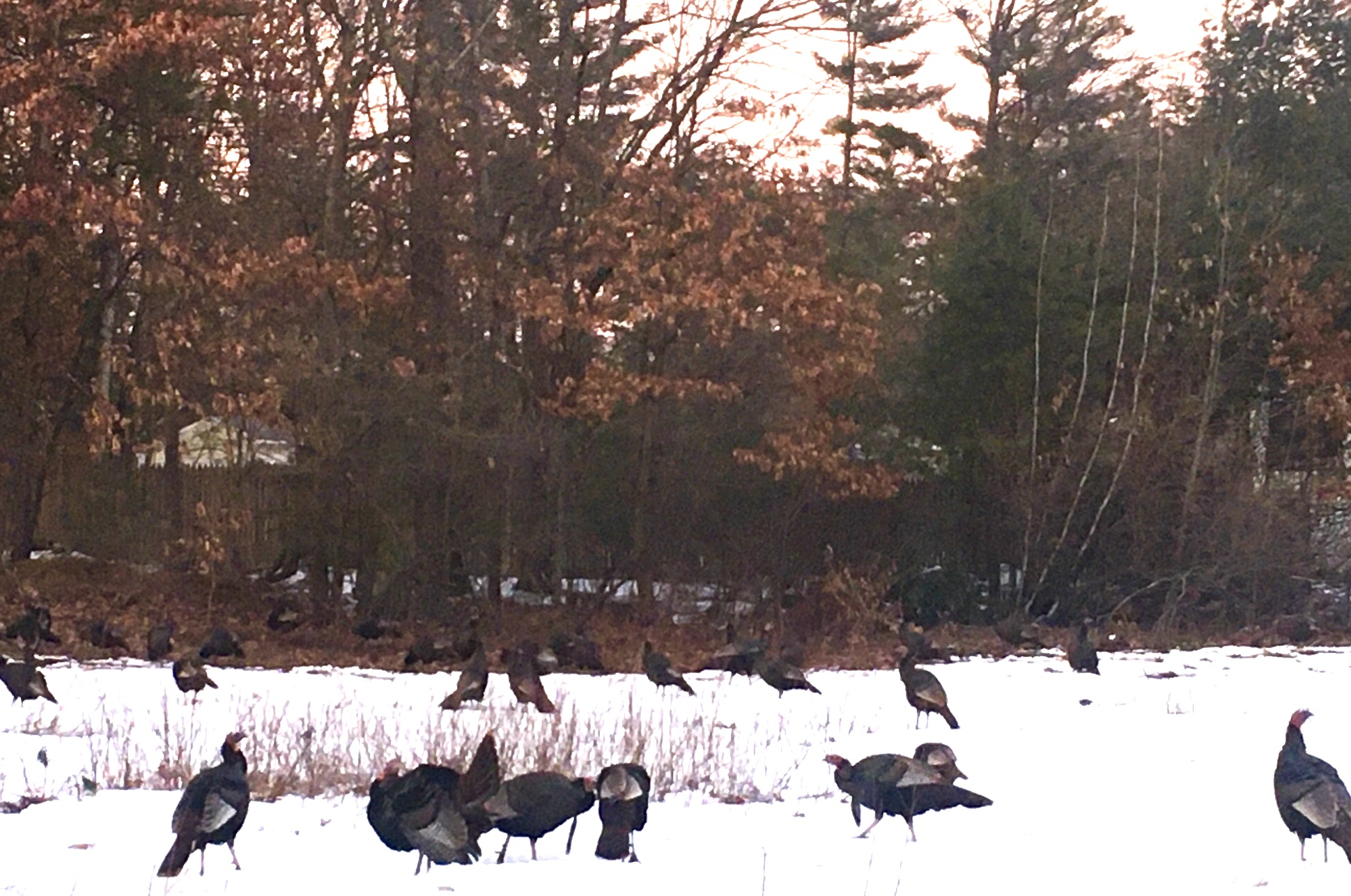
We share our suburban development with a flock of wild turkeys. My neighbors and I are accustomed to seeing them a few at a time in our yards throughout the year, patiently gobbling up spilled seed beneath bird feeders or checking out freshly-turned soil in our gardens. The flock has grown over the past several years, and I counted 57 turkeys a few weeks ago, pecking and scratching under nearby power lines for whatever food they could find. They’re habituated to us, but still wild.

Wild turkeys flocking together, late winter. Ellen Kolb photo.

I’m used to hearing gobbling and clucking, along with the occasional thumping whoosh as a turkey takes ungainly flight, usually at just the right altitude to match the grille of an oncoming car. On my recent sunset walk, I heard that whoosh, then another and another. Soon I came upon the cleared space under the power lines, and there they were: dozens of turkeys, taking flight one at a time, not to torment motorists but to head into the nearby pines to roost.

I’d never seen a flock at sunset. I stood fascinated, watching them ascend to their chosen spots. There were a few kerfuffles as some of the roosting birds objected to having their space invaded by later arrivals, but there was ample room in the stand of trees for all of them. Soon the clucking subsided to softer sounds, and the whooshes came to an end.

The timing was none of my doing. I just got lucky. Pretty good stuff, for a spur-of-the-moment walk.

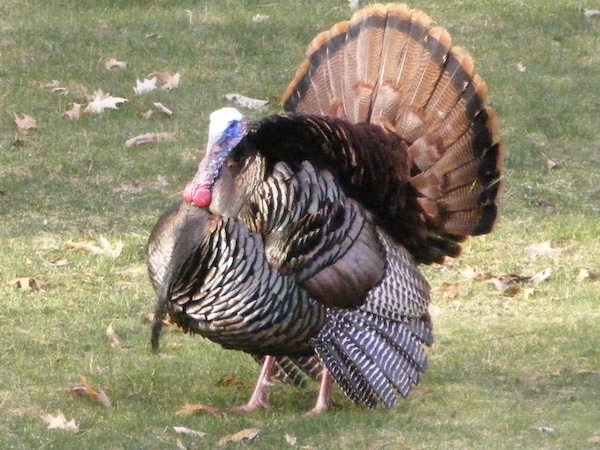
male wild turkey displaying feathers
Male wild turkey, posing for his portrait. Ellen Kolb photo.

According to New Hampshire Fish and Game, wild turkeys were successfully re-introduced into New Hampshire in the 1970s, after more than a hundred years of absence due to habitat loss and overhunting. Since then, the turkeys have been thriving. Too thriving, it sometimes seems: I think every driver in the state has at one time or another had to stop for a bunch of turkeys crossing a road, always one bird at a time, moving at an infuriatingly leisurely pace.

I’ve grown a bit more patient with the big fowls as they’ve moved into the neighborhood. I’ve seen them throughout the year, courting and squabbling and caring for their young. Without meaning to, I’ve picked up a bit about the rhythm of their lives. They’re remarkable, even if they do act as though they own the roads.

Updated 2026 to revise web link.

Teamwork makes solo walks possible

I was on the Nashua River Rail Trail for a few miles this weekend. I couldn’t help noticing freshly-cut logs and branches along both sides, thanks to volunteers I’ll probably never meet. Breezes and recent heavy wet snow had brought down trees all over the place. On the northernmost stretch of NRRT, the mess is cleared. All I had to toss aside were a few small branches.

Nashua River Rail Trail: winter winds brought down a tree, and volunteers cleared away the mess. Fence-mending will wait.

Not so upstate at one of New Hampshire’s largest ski areas which I recently visited. It’s one of the few ski areas in the state with a decent system of trails for Nordic skiers and snowshoers. While the resort’s management is understandably focused on the downhill ski trade (that’s where the money is), there’s not enough staff to keep the snowshoe/fat bike trails cleared, at least not yet this season.

I’ve kept an eye on websites reporting on New Hampshire rail trail conditions. Many of the rail trails are much longer than NRRT and have that much more of a mess to clean up. Enter the snowmobile clubs: I’m aware of two in particular in the southwestern part of the state that put out calls for volunteers for workdays this weekend. I’m sure that snowmobile clubs all over the state are doing the same thing, as pretty much every region got hit by storms over the couple of weeks.

Those clubs are doing work that will make walks much easier for me year-round, not just in winter. Grooming snow, clearing deadfall, and mowing grass take time and equipment and volunteers. I like walking alone, but some of the most enjoyable trails I know wouldn’t be accessible or pleasant without the work of many people. My solo walks benefit from teamwork.

Want to say thanks to the snowmobile clubs? Send a donation, even if you’re not a member. Include a note saying that you’re a grateful hiker. The New Hampshire State Parks website provides a list of clubs, and you can look up a club’s social media accounts (usually updated much more frequently than websites) to find contact information and to keep track of opportunities to volunteer for trail work.

My winter walks thus far have mostly been close to home, in neighborhoods and municipal parks. Those routes could use post-storm help, too. Your town’s parks and rec department or conservation commission might put out a call for volunteers on specific cleanup projects. Be on the lookout for such announcements.

And if you happen to come across some folks doing trail maintenance while you’re out and about, stop to say thanks.