Ice storm recovery

The December 2008 ice storm in southern New Hampshire, now four months past, has become a reference point for all my observations of southern NH trails this spring. I recently visited Miller State Park and Pack Monadnock to see how recovery is going.

I can’t begin to speculate on how many people it has taken to return trails around here to usable condition. The auto road, still gated to keep cars out, is clear all the way to the summit. The road sports a new edging of wood chips and sawdust from all the overhangs and broken limbs cleared from ice-damaged trees.

park road lined with ice-damaged trees
Auto road at Miller State Park, Peterborough, NH, showing tree damage from ice storm.

The lower end of the auto road is now clear, with deadfall and snapped tree limbs piled at the road’s edges. Hardwoods predominate at the base of the mountain, and they took the brunt of the storm damage. The destruction must have seemed overwhelming to the first people who came by to check it out just after the storm. The cleared road testifies to a lot of effort since then. Even so, I was stunned for a few minutes when I got out of my car and had my first look around.

The few other cars in the lot when I arrived belonged to members of a trail-clearing party of Friends of the Wapack. The group’s web site says that there will be a work party somewhere along the trail every weekend this season, and this must have been Pack Monadnock’s turn. I heard a chainsaw being used in the woods off to my left as I descended from the summit later in the morning.

I decided to walk up the auto road, wondering just how blocked the Wapack and Marion Davis trails must be. I brought my camera in the hope of seeing some wildflowers growing low to the ground, but there has been way too much cleanup activity along the road to allow anything to sprout along the edges. I don’t doubt that there are plenty of flowers farther from the road and along the trails. I did see lots of buds on trees and shrubs, reminders that the forest will recover as it always does after one of Nature’s big events. One tree had lost its two main limbs and looked pretty sorry, but that didn’t stop a bird from working on a good-sized nest in one of the branches that was left.

The road’s a mile & a quarter long, and it rises 700 feet. Towards the summit, where evergreens take over from the oaks & maples & birches, there is much less tree damage. The evergreens seem to have shrugged off the ice and bounced right back. The last few hundred yards of the road have blue blazes on nearby trees, and that made me wonder if the Marion Davis trail has been re-routed for a distance.
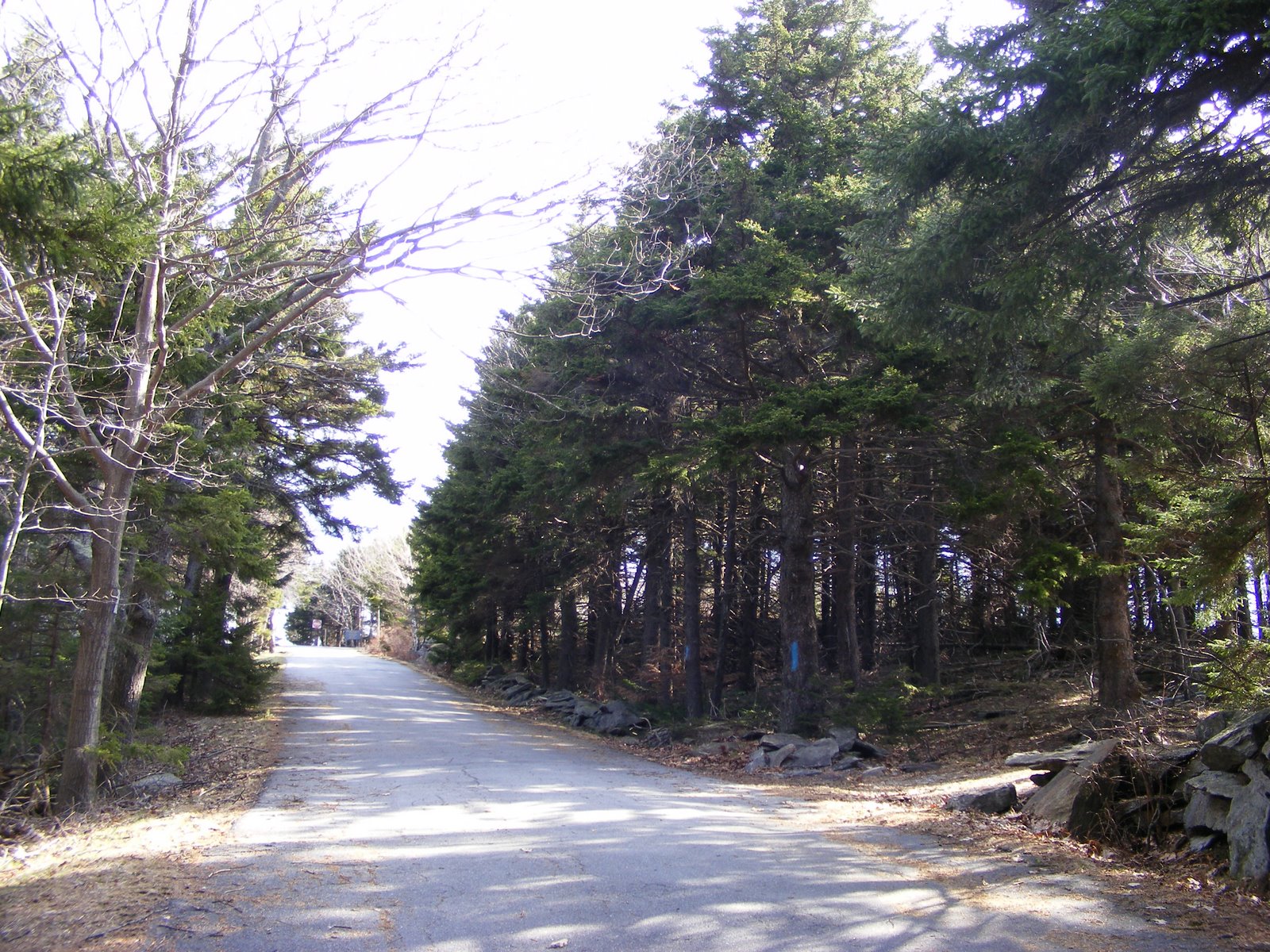
auto road at Miller State Park, New Hampshire, with evergreen trees lining the road
Miller State Park auto road: evergreens near the summit weathered the ice storm much better than the hardwoods at Pack Monadnock’s base.

The summit, without summer crowds, was a fine place to be. The view of Monadnock always pleases me, even on a hazy day. The cool morning was giving way to an 80+ degree afternoon, with a brisk breeze up on the landing of the fire tower. I later perched on a picnic table with my water bottle, looking over towards North Pack in its shades of green & grey. Close up, the woods show damage. From a distance, they look like they’ll be around long after I’m gone, which of course is exactly the case.

When I was here last fall, New Hampshire Audubon had volunteers at its raptor observatory near the summit, identifying birds in the fall migration. I was lucky enough to catch sight of a golden eagle that day. This weekend was different, with migration season long past. There wasn’t so much as a turkey vulture soaring overhead. I settled for chickadees in the woods.

One Subaru – or more precisely, one Subaru’s driver – drove around the closed gate to the auto road, surprising me on my way up. Aside from that, I had very little company: a half dozen dog walkers, one intrepid bicyclist, a lone runner. I was therefore unprepared for the sight in the parking lot when I finally got back down a little past 11 a.m.: more than 40 cars, with more coming in by the minute. That suggested to me that the Wapack Trail up the mountain must be in fine shape, since all the people from those cars had to be somewhere, and they weren’t on the auto road.

The ice storm left scars on the land, but recovery is underway. I’m grateful to all the volunteers whose work is bringing the trails back to life.

One for the bookshelf: “New Hampshire Rail Trails”

I found a great book while I was browsing the table from Bondcliff Bookstore (Littleton, NH) at the recent Made In NH Expo. New Hampshire Rail Trails by Charles F. Martin (Branch Line Press, Pepperell MA, 2008) is going directly onto my shelf full of guidebooks, and will probably be in my backpack on several trips this year. He covers trails all over the state, offering the history of the various rail lines and the prospects for development of more trails. It’s not an encyclopedia, but he manages to cover quite a bit in 300 pages, including maps and a long list of organizations supporting these trails. Development of some trails is proceeding so quickly that even some of Martin’s 2008 information is outdated, but that’s hardly bad news. Martin notes which trails are likely to see extension or upgrading in the near future.

I’m delighted with this book. I’ve already made note of a trail he describes up in Bethlehem. I have a racewalk in that pleasant town next weekend, and I’ll head for the trail as soon as the race is over.

New Year’s Day, after an ice storm

Most of southern New Hampshire endured a severe ice storm as 2008 came to an end, and I’m sure I’ll be seeing the aftermath for months to come. I was heartened by what I saw in the hard-hit town of Temple on New Year’s Day. Broken branches lined the roadsides, but no roads were blocked by fallen trees. I saw half a dozen utility trucks making their way through town, their crews set on restoring service to neighborhoods that have gone without for some days now.

The trails around here, unlike the roads, are still a mess. I needed today’s outing to restore my optimism for the pace of recovery from the ice storm. Monadnock State Park is still closed. The Friends of the Wapack have posted a message on the group’s web site warning against hiking the trail for the time being, since the tree damage has rendered the trail “very hard” to follow. My favorite cross-country ski area was shut down by the storm, and the owners are doing heroic work to arrange for the extensive logging and cleanup necessary to restore at least a few kilometers to skiable (and hikable) condition.

Today proved that things are looking up, after a messy weather event that’s going to be remembered for years to come.

Horse Hill in Merrimack is ready for you

Horse Hill Nature Preserve in Merrimack, New Hampshire almost didn’t happen. Town residents voted awhile back to purchase the land from a developer, and then they worked to make the property into a recreational asset for the town. Today, it’s ready for you to discover.

I’m happy that I can finally go to HHNP and spend several hours wandering around on marked trails without having to maneuver around junked cars and piles of spent shells from years of target practice on the land. I owe thanks to a lot of volunteers. The whole area’s cleaned up, and the trails are marked much more clearly than they were last year. The parking lot off of Amherst Road has been plowed out every time I’ve been by there this season, which means the town is making an effort to keep the preserve accessible year-round. I can spend an afternoon there without retracing my steps.

HHNP is going to become more important as Merrimack grows and new residents seek outdoor recreation close to home. It’s great to see this asset ready for the future.

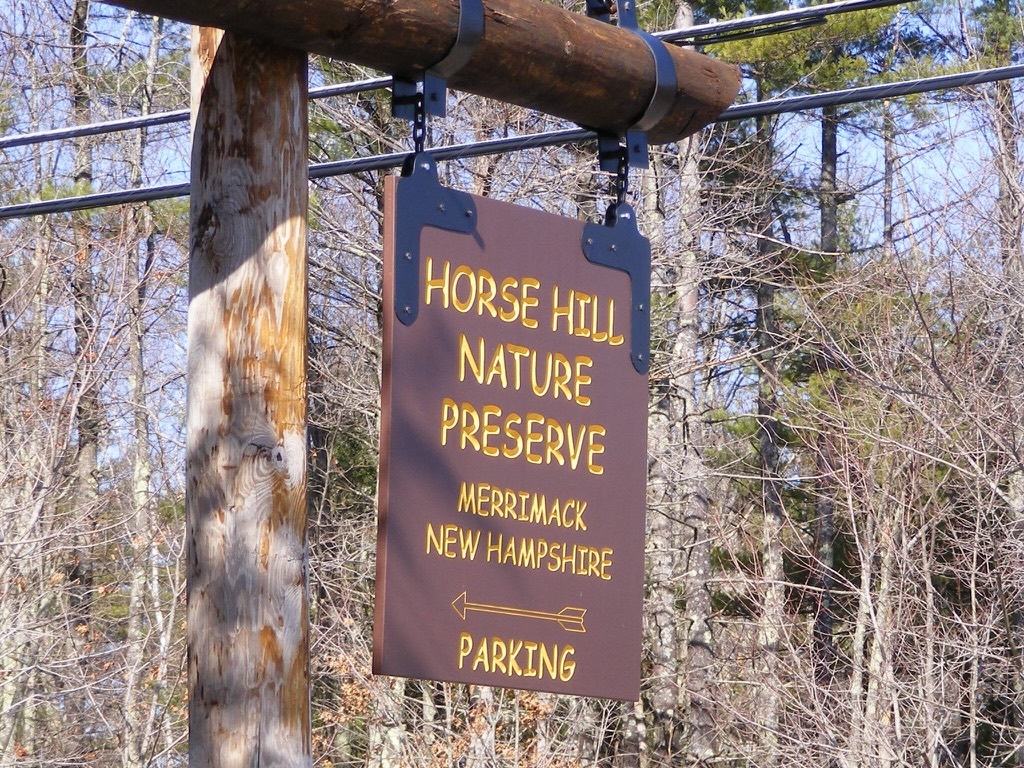
sign for Horse Hill Nature Preserve in Merrimack, New Hampshire

Wantastiquet’s east side, Chesterfield, NH

Months after reading about the Chesterfield (NH) Conservation Commission’s work to link Wantastiquet Mountain with Mount Monadnock, I finally got out to Wantastiquet’s east side to look around the area. I’m impressed at the work the Commission’s volunteers have done! Obviously, a lot of people are cooperating to make good things happen.

I started walking from the Madame Sherri Forest trailhead on Gulf Road. (Parking is limited; take care not to park on nearby private property.) There’s a network of short trails throughout the forest, with a couple of them stretching out to nearby hills. I took the Ann Stokes loop to Indian Pond in order to pick up the trail to Wantastiquet Mountain. I’ve been up Wantastiquet a couple of times from the west side in the town of Hinsdale, and I was curious about whether it’s now possible to follow an established trail up the east side from Madame Sherri. Short answer: yes. The trail from Indian Pond isn’t blazed or flagged but is fairly well-beaten and clear.

(Update, February 2026: the Wantastiquet-Monadnock Trail is in place. Learn more at the website of the WMT Coalition.)

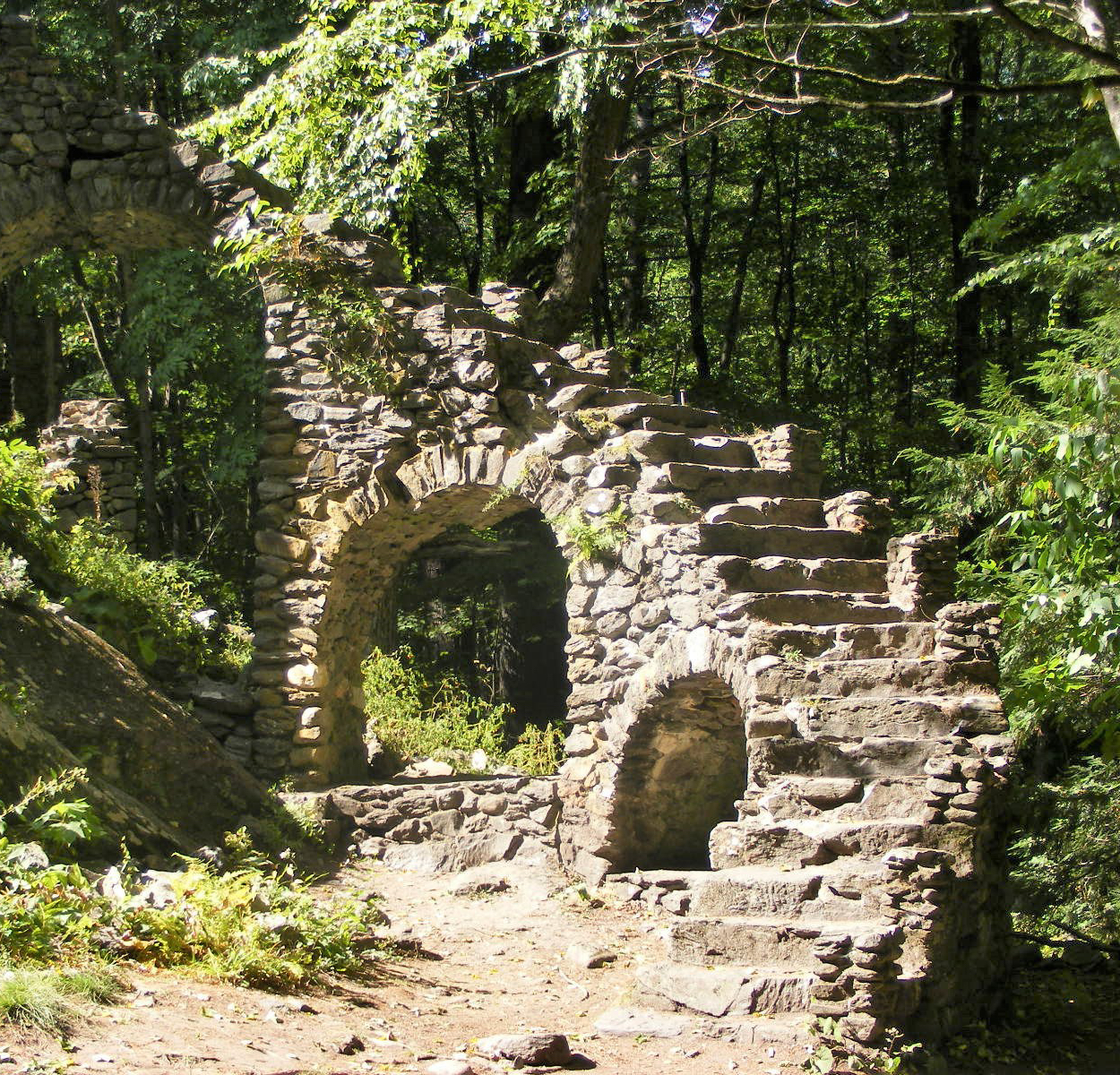
ruins of "castle" at Madame Sherri Forest, N.H.
Madame Sherri’s castle, in Madame Sherri Forest, Chesterfield N.H., east of Wantastiquet Mountain.

December on Mount Monadnock

I had never before been tempted to approach New Hampshire’s Mount Monadnock in December, but today’s fall-like conditions were too good to pass up. An early December with next-to-no snow is rare on the mountain. Monadnock isn’t a frequent destination for me, but each visit rewards me with good views and a variety of trails. The mountain sometimes sends me home with a lesson or two as well, and it did so today with some firmness.

What amazing conditions! Trail runners in t-shirts and shorts zipped past me. There was mud along the way, and skims of ice were forming in spots, but the going was mostly easy. I ascended via the Cascade/Red Spot/Pumpelly trails, deciding along the way to go clear to the summit even though that hadn’t been my original plan. I’d never been on either Red Spot or Pumpelly, and they were a nice change from the Halfway House and White Dot trails. My first few trips up Monadnock were on the steep and crowded White Dot trail that begins near park headquarters. I swore to myself after those hikes that I’d never go back again. Then I finally got smart and started taking other trails. What a difference!

The blazes on Red Dot could stand some repainting, but the trail is pretty wide and easy to follow. It helps to have patience to go along with the trail map. (Don’t ever start up Monadnock without a map, which you can pick up at park headquarters. There are many trails, and it’s easy to get lost.)

I noticed things I can’t see when the trees are in leaf. For once I got to see Monadnock’s songbirds, not just hear them. I’m not sure if they were singing just to delight me or if they were making noise to warn their neighbors about the approach of a noisy hiker. I saw ground-level ice formations, some of which were quite beautiful.

I shared the summit with a grand total of three people. That’s December for you. (I was once there on a Columbus Day weekend with about 150 people.) The wind at the summit was too brisk for me to sit and enjoy my lunch there. I lingered for about five minutes, treasuring the quiet and the views, then started down to beat the sunset. It was 2:30, with sunset coming at 4:15. I had to scoot, so I resorted to White Dot, the most direct route back to my car. Big mistake.

White Dot heads down rather precipitously. Every Cub Scout in southern New Hampshire has probably scampered up and down that trail at one time or another, but I don’t like it one bit. I had a trekking pole, and I needed it. I walked slowly enough that one passing hiker asked how I was doing. I assured her I was fine. A few minutes later, my cautious pace proved to be not cautious enough, somewhere between White Dot’s junctions with the old ski trail and Cascade. Not once, but twice, I slipped in mud and went bumping and sliding until I hit solid pieces of granite. The first fall snapped my trekking pole. The second was downright humiliating. I was grateful I had no audience. Of course, if I had injured myself badly, my solitude would not have served me well. I take my chances when I hike alone.

Once I got up and brushed off the mud, my pace slowed still more as I babied a sore ankle. I had an uneasy feeling about getting back to the parking lot before sunset. I had all the standard dayhiker gear including a flashlight, but I hoped I wouldn’t need it. As it happened, I got to the car at precisely 4:15.

I will undoubtedly feel the bruises tomorrow, but the hike was worth the effort. I still hate White Dot, but that’s not the same as hating the rest of the mountain. I’d like to go back in the wintertime, after a good snowfall, and snowshoe all over the lower slopes. There’s a prospect to warm a flatlander’s heart.

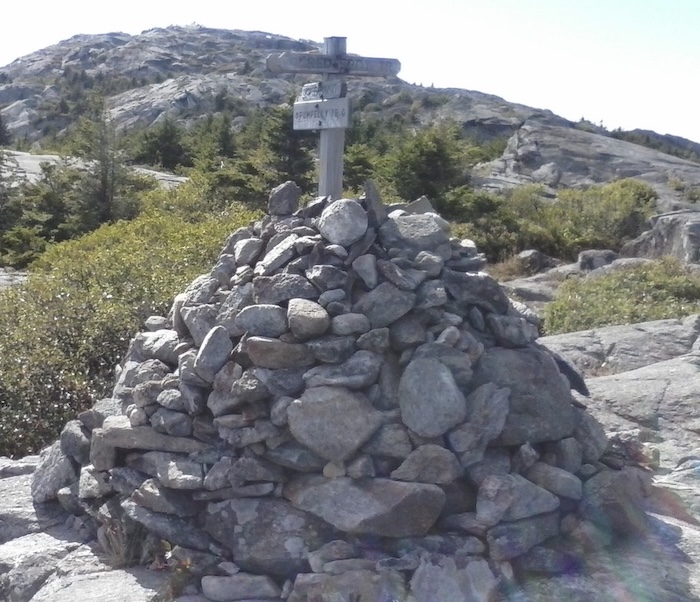
cairn at trail junction on Mount Monadnock, New Hampshire
From another season’s hike: junction of Pumpelly and Red Spot trails, looking toward Mount Monadnock’s summit. Ellen Kolb photo.