I walk for fun, to explore, to more-or-less exercise. I also walk to keep my head on straight. I wouldn’t have gotten through today without a couple of miles outside.
I’m a political critter, you see. I’ve been a campaign staffer, an activist, a blogger from the New Hampshire State House, to name a few pastimes. Yesterday was election day after the nastiest campaign year I’ve ever experienced. This has been a backed-up-sewer of a season.
Nothing will flush it out except time on the trails.
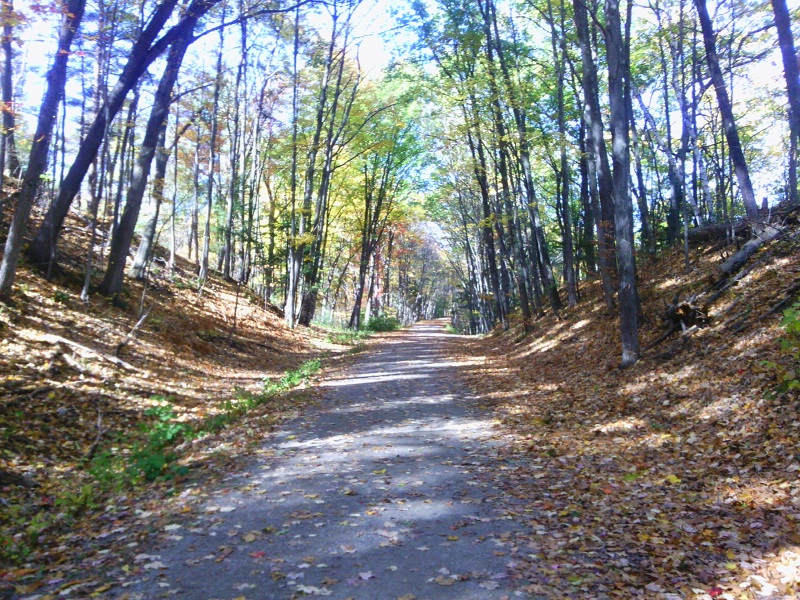
I had time today for a couple of local miles. Manchester’s Piscataquog rail trail came through for me. There were enough leaves left on the trees to serve as a canopy. The overcast sky suited me; bright sunlight would have left me with a slashing headache.
Forty good minutes: enough time to escape agitation. Time to block out the noise, turn away from the news feeds, take lots of deep breaths, recall what’s important.
A man biked past me. I recognized him as the unofficial adopter of the trail, picking up bags of trash, neatly hanging fresh plastic bags every hundred yards or so. Seeing him was oddly consoling and reassuring. He has a simple, selfless volunteer’s dedication to an unsung job that consists of keeping a public area pretty.
Beat that, candidates.
Decompression is going to take awhile. Today’s walk was a good start.
New Hampshire’s Piscataquog Rail Trail finally reaches across the Piscataquog River, connecting Manchester with Goffstown. I put off some workday tasks long enough to walk the trail from its east end all the way across the new bridge. With all due respect and gratitude to the many people who made the project happen, I didn’t stay for the ribbon-cutting and speechifyin’. Trails are for walking.
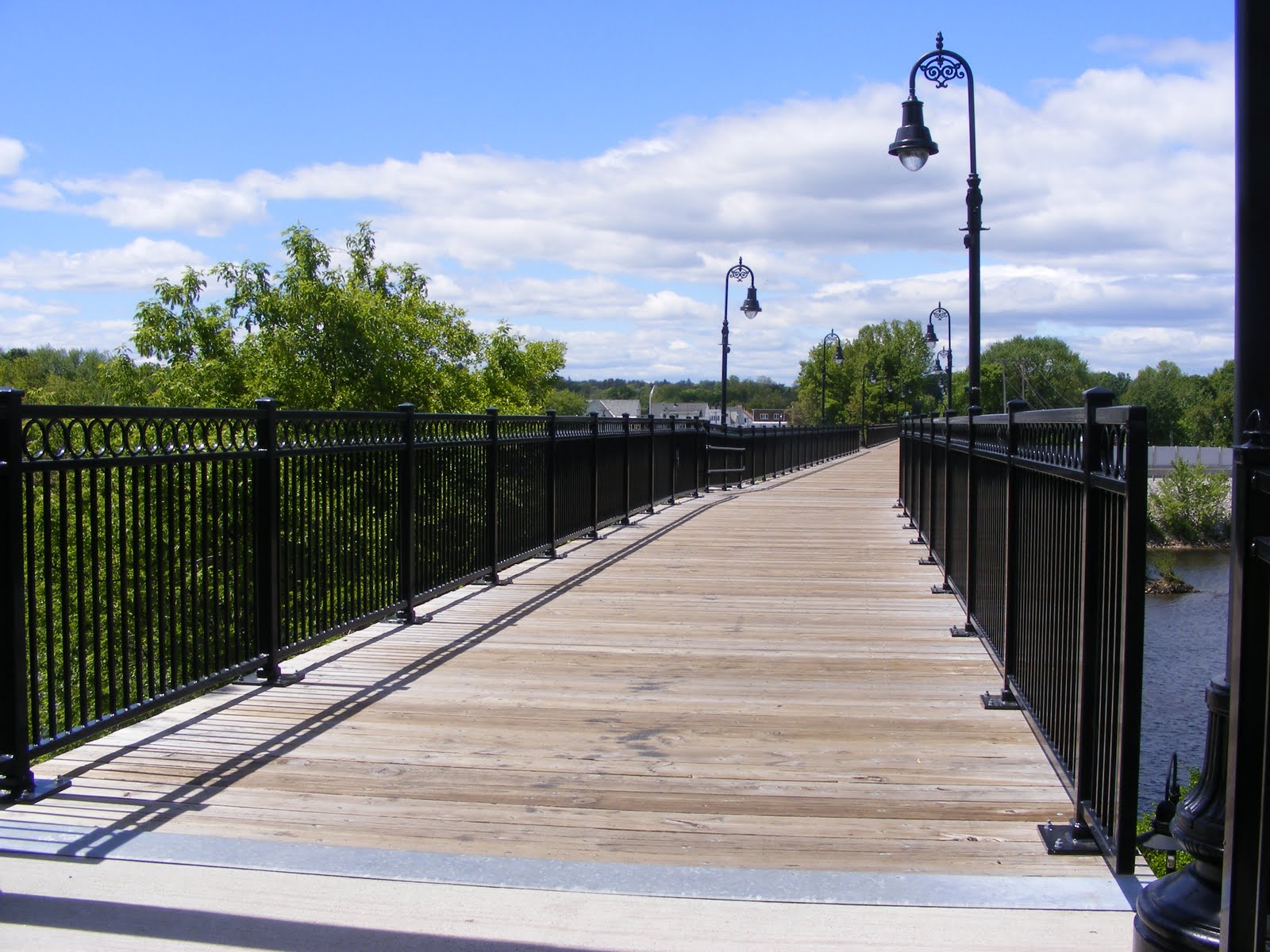
On the Manchester side, looking toward Goffstown, at long last. Ellen Kolb photos.
On the Goffstown side.
I call this right neighborly.
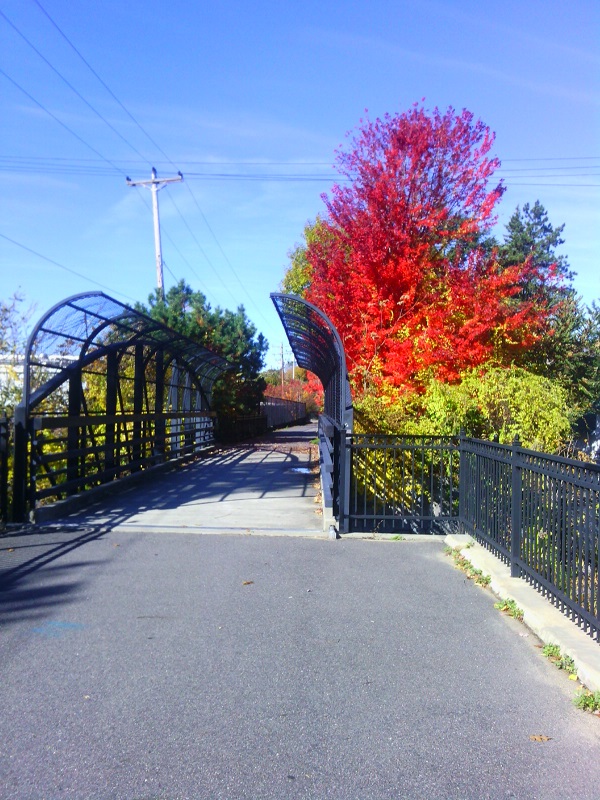
Second Street bridge, near east end of Piscataquog Rail Trail.
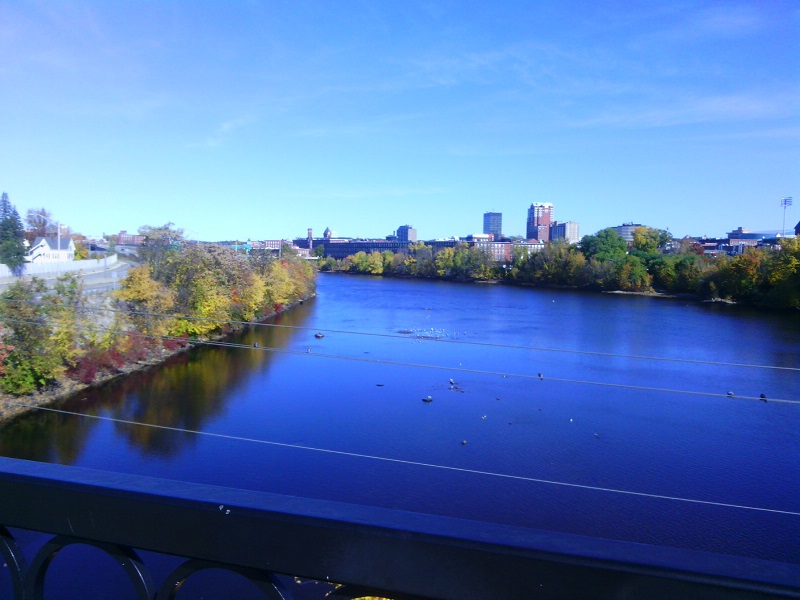
The Queen City: Manchester, New Hampshire, seen from the Hands Across the Merrimack bike/ped bridge.
The Singer family is behind many philanthropic efforts in the Manchester area. Their generosity helped to complete the bridge project.
I was early for the New Hampshire Fisher Cats game a few days ago (that’s baseball, for all you out-of-towners). It’s been too long since my last stroll over the Hands Across the Merrimack bridge, part of the rail trail that begins behind the baseball stadium and extends a couple of miles west along the Piscataquog river, clear over to West Side Arena.
The Hands Across the Merrimack bridge over the Merrimack River, seen from the trail behind Northeast Delta Dental Stadium.
The odd bit of graffiti aside, the bridge is in good shape structurally and aesthetically. And for crossing the Merrimack river, it sure beats dodging the auto traffic on the nearby Granite Street bridge.
Manchester, New Hampshire
View from the west end.
It’s good to see this acknowledgment of one of the people who made the Hands Across the Merrimack bridge project happen.
It took a whole lot of people, headed by Manchester resident Helen Closson, to make a pedestrian bridge out of the abandoned rail bridge across the Merrimack River in Manchester, New Hampshire. Closson called the project “Hands Across the Merrimack” while it was underway, and whatever name the pedestrian bridge may be given officially, that’s the name I’ll remember.
I’ve been on the bridge before, just for the fun of crossing over the Merrimack on foot. Today, after some business in town, I took advantage of the sunny afternoon to walk the rail trail clear across Manchester’s West Side. This is Manchester we’re talking about, so “clear across” means about two miles.
Starting from the baseball stadium where the Fisher Cats play on the river’s east side, a paved walkway runs parallel to the Merrimack and shortly comes to a fork. Going right would have brought me under the rail trail and onto some private property. Going left brought me around a sweeping curve to the approach of the Hands Across the Merrimack bridge.
I was a bit startled to find a sculpture of a steer just short of the bridge. The plaque mounted nearby noted that the statue was a tribute to workers & entrepreneurs like the ones from the former JacPac meat processing plant located nearby, now the site of a hospital expansion.
Vandalism has become an issue along the trail, judging from some news reports I’ve read. It looked good today, though. I’m sure that’s an ongoing effort by people who care. The trail is paved its entire length, and the pavement’s in good shape.
The bridge is at the southeast end of a trail that parallels the Piscataquog River. For now, the northwest end of the trail is near what I call the Kelley Street bridge (Nazaire Biron Bridge on my map) that links the West Side with the Pinardville neighborhood. There’s a very hazardous crosswalk on Main Street, but the few other road crossings are in quiet neighborhoods. The trail, like the rail line before it, goes on a bridge over Second Street, avoiding a road that’s just as busy as Main Street.
The Piscataquog River snuck up on me. I cleared Main Street & followed the trail behind a house where there was a cheerfully noisy party going on. As the music from the party faded behind me, I became conscious of the river’s sound, and soon the river was in view. A few weeks ago, we had heavy rains, and this river was particularly pesky for the people living along it. Today, though, it was a tame & pretty thing. Several dirt trails ran steeply from the trail down to the river. I stayed on the pavement, worried that I’d twist an ankle trying to negotiate the slope in my sneakers.
Eventually, I came to some ball fields, where a softball game was just wrapping up. Soon I was in sight of the ugly red bulk of West Side Arena. The building’s homely appearance belies its worth as an athletic facility for what seems like every kid on the West Side. Soon I passed under the Kelley Street Bridge and reached what is now the end of the trail.
Once upon a time, this rail line crossed the Piscataquog near Kelley Street, and then paralleled the river (on its north side now) through Goffstown & into New Boston. Patches of the line have been developed into trails. I’ve been on one segment in New Boston near where the middle & south branches of the Piscataquog converge — a beautiful spot. In Goffstown, determined residents have turned part of the old railbed into a trail, and they continue to try to finish the link between New Boston & Manchester.
[Update, 2015: that link, a bridge over the Piscataquog River, was completed in 2015. Trail users can go from Manchester’s baseball stadium all the way to Goffstown center.]
For now, though, all I saw after crossing under Kelley Street was a fenced-off trestle hung with “Keep Off” signs. I suspect that tight municipal budgets and concerns about liability will keep that trestle from ever being turned into a pedestrian bridge. Of course, that’s what I used to think about the bridge across the Merrimack. [Update: five years after I wrote this, the Piscataquog River trestle was indeed rebuilt, thanks in part to the generosity of the Singer family.]
This is not a path I would take after dark. I have no problem visiting on a weekend afternoon in broad daylight.






 Granite State Walker