I’m downright embarrassed. I haven’t been on any hilly hikes lately (save one, about which more below). I haven’t explored anyplace new. Nothing long, despite my good intentions about training for an autumn attempt at the Cross New Hampshire Adventure Trail. My recent challenges have been on the order of going up stairs without pulling the railing out of the wall.
Shut up, knees. I’m trying to hike here. I’ve been muttering that a lot since a mid-May mishap in which I banged up both knees, one worse than the other. A few weeks ago I tried a hike up South Uncanoonuc in Goffstown, New Hampshire, which with its twin to the north is the first place I go when I test how rehab from injury is going. Nice views, bad judgment. My knees and I have barely been on civil terms ever since. Flat is fine, stairs not so much.
But oh, a stop on a South Uncanoonuc ledge was refreshing. I had a view to the west-southwest, towards the Monadnocks, with Grand Monadnock itself peeking from behind the Wapack range.
I’ve since been walking on easy paths with their own attractions. One of my town’s conservation areas is home to a heron rookery that’s too far away from shore to be captured by my phone’s camera. I pressed my family’s “real” camera into service, to good effect. The juvenile herons are growing fast.
The Nashua River Rail Trail can still surprise me, even after a hundred or more visits. I spotted a trailside blossom the other day that I’d never seen before. Goat’s rue, if my phone’s plant ID app is accurate; I welcome correction from any reader who knows better. In a year when poison ivy and knotweed threaten to overwhelm the trail’s usual flora, this was a treat to find.
Annoyed as I am to be on limited duty, I can see this will be a beautiful summer. May you find pleasant surprises on your own Granite State walks this season.
My spring hiking has been hobbled – literally – by a bruised knee. Sounds trivial, but it’s a nuisance. No hilltop vistas for me in May. Fortunately, with rail trails and local conservation areas, I’ve had options. And May was a month for wildflower hikes.
April showers did exactly what the old rhyme says they do. Before taller plants were ready to flower, ground covers were blooming. I appreciate the tiny flowers that announce the end of mud season. I love the way their colors punctuate the season’s new growth. Certain flowers seemed to be everywhere I walked: purple fringed polygala, starflower, bluets.
fringed polygalastarflowerBluets
Others were harder to find. In the conservation area closest to my house, I searched in vain for two weeks for trillium before finding a single one. I spotted no lily of the valley until the last week of the month.
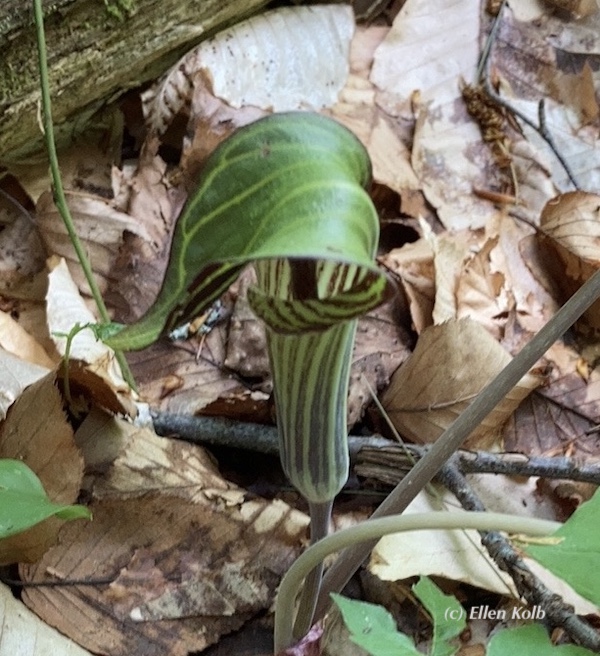
To my delight, I did find a jack-in-the-pulpit on a trail in the next town over. That odd little plant might be everywhere, but I hadn’t spotted one before. It’s just a few inches high. I only found it because it was tucked right next to a particularly vigorous shoot of poison ivy, and its foliage didn’t seem to match. I carefully nudged the poison ivy’s leaves aside and was rewarded with the day’s prize sighting.
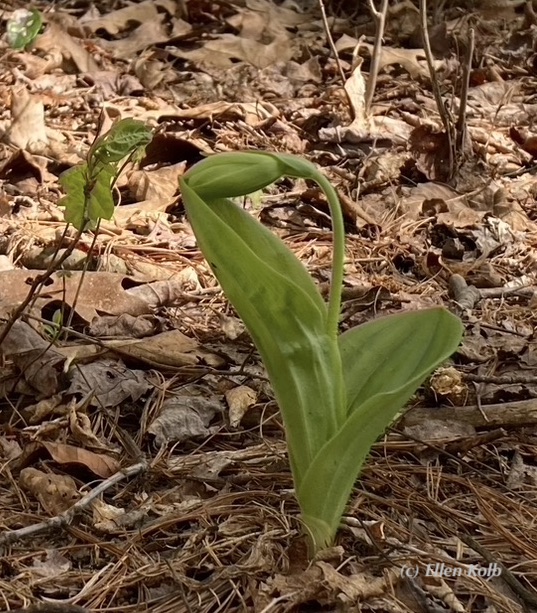
The ladyslippers always seem to spring out of nowhere in May. This has been a good year for them. A friend sent me an email one day about a certain trail we like, saying “ladyslipper alley coming next week.” Indeed! One day they were nowhere in sight even though I knew I was standing where I’ve seen them in other years. A week later, I spied a few pairs of ladyslipper leaves cautiously stretching out as though they were reluctant to give up shielding the flower stalks inside. Within just a few days, the stalks were upright, each one a good eight inches high or more, each bearing a striking blossom. Nothing tiny or modest about these ephemeral spring beauties. They show off like divas for two weeks, then it’s goodbye until next year.
ladyslipper in bud……and in bloom
Garlic mustard, an unwelcome guest.
Not everything blooming in spring is delightful. Invasive plants along my local trails threaten to overpower native vegetation. I found a patch of unfamiliar flowers making themselves at home at a nearby trailhead. A phone app backed up by some information from UNH’s Cooperative Extension service helped me identify the plant as garlic mustard. That inoffensive-looking pest will spread all over the forest floor if it’s left unchecked, crowding out the woodland wildflowers. I pulled up what I could, and I’ll be back to pull some more, disposing of it in the trash and definitely not in the compost pile.
June might see me back on the hills as my knee heals. I call North Uncanoonuc in Goffstown my rehab hill, because that’s the first place with any elevation that I go to post-injury. I hope to be there soon.
My Substack newsletter Braided Trails will soon include excerpts from Granite State Walker as well as original material inspired by New Hampshire trails. I hope you’ll subscribe.
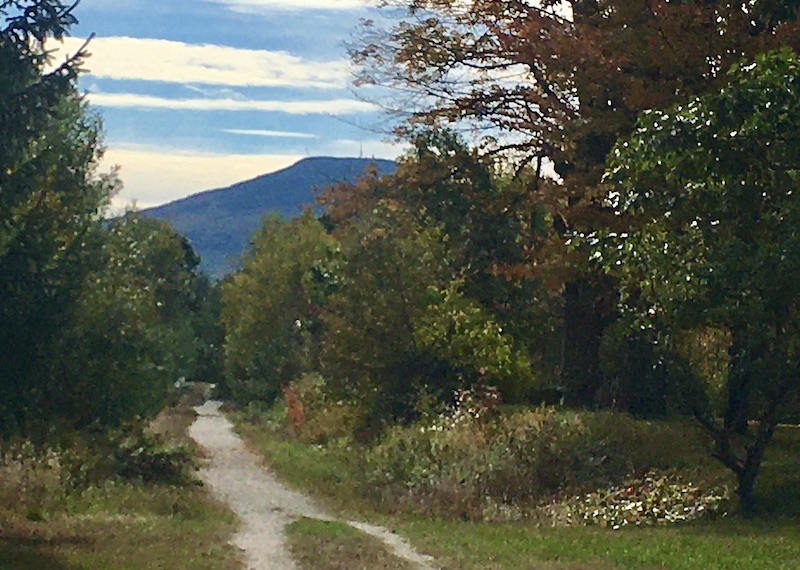
Mt. Kearsarge seen from the Northern Rail Trail, Wilmot
So why the addition? Here’s an excerpt from my intro to Braided Trails:
Readers have been curious or kind enough to follow me down various paths through the years. New Hampshire hikers have kept Granite State Walker going. At Leaven for the Loaf, I’ve reported on pro-life projects and legislation at the state level. My eponymous blog has been a promotional portfolio where I’ve also explored aspects of my Catholic faith.
But omigosh, what if the hikers don’t like my politics or my State House readers don’t care about my hiking or somebody somewhere is put off by a portfolio from a Catholic scribbler? I’ve tried to keep you all a secret from each other.
Enough already. Welcome to Braided Trails.
“Braid” is a nod to the three distinct blogs I’ve launched since 2006. This Substack is a place where each theme can get its due, in context with the others: braided, not fused. It’s about time I found a space big enough to bring the whole blessed lot of us together. It’s big enough for new readers, too.
Intrigued? Then I welcome you on board. Subscribing is free. And if you’d prefer to stick with this blog, plain and simple, that’s fine, too. I’m delighted to write for you in either case.
Thanks – and I’ll see you on the trails.
Spring is here, summer’s coming…and so is Braided Trails.
Long ago when I began exploring Granite State trails, I had a little point-and-shoot film camera that I carried everywhere. I have a shoebox full of prints from those early outings: evidence of an utter beginner. I didn’t know how to frame a shot. I didn’t know that it was hopeless with the fixed lens I had to get a focused close-up of a trillium in bloom. I had trouble holding the camera steady.
Even so, a few of those old prints remain special. They documented my first views of places that I later came to love. Some of those first impressions were dramatic, others much less so. I had no way of knowing that the gifts of time and memory would draw me back to certain places over and over again, seeing and learning new things with each visit.
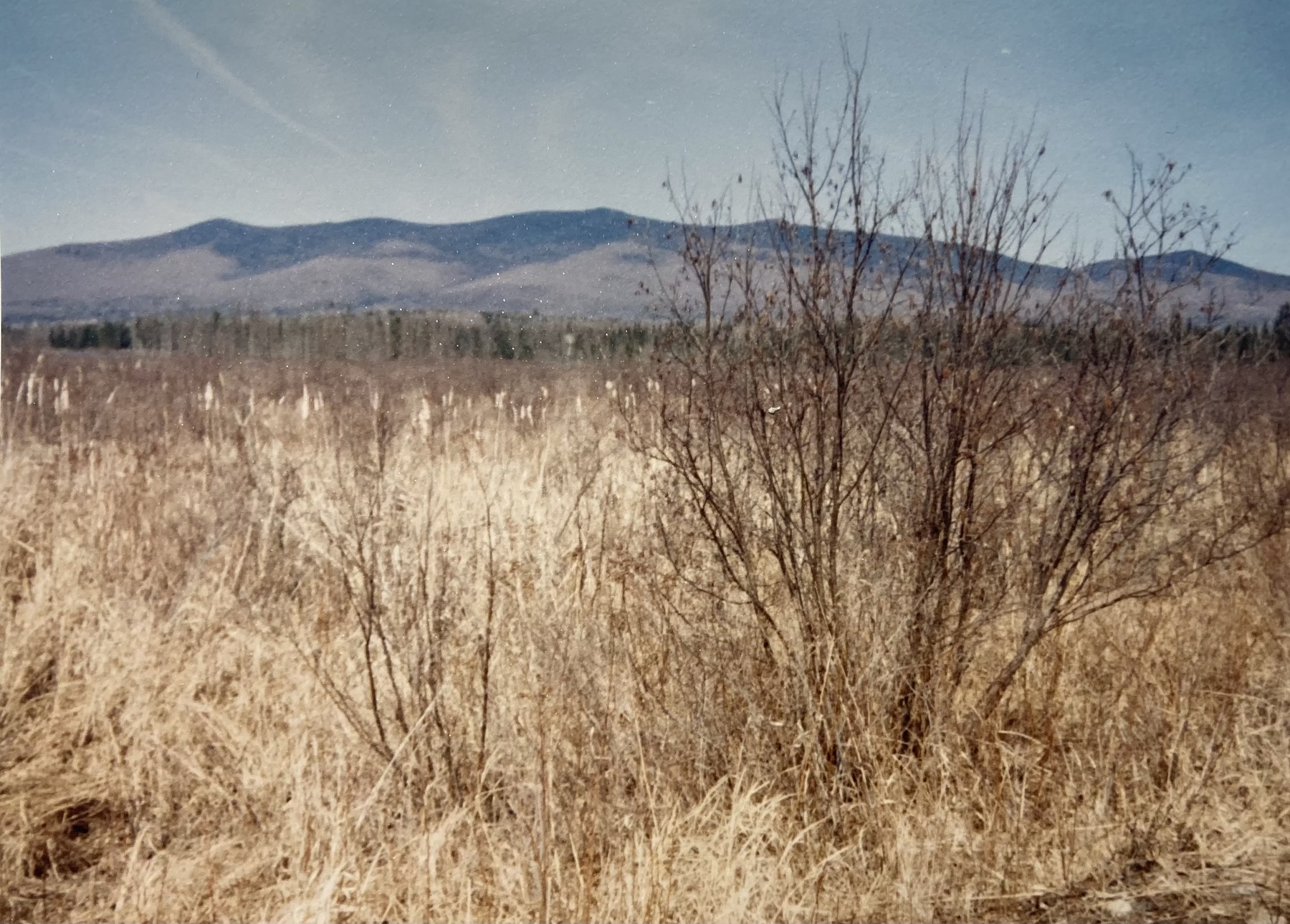
My very first sight of the Pliny Range from the marsh near Cherry Pond was on an April day as I made my first visit to the Presidential Rail Trail. Spring was playing hard to get. I took a photo that captured trees not yet in bud and grasses clad in the dullest of colors. Something about those hills in the distance appealed to me, though, and I wanted to capture them, too. So I snapped the shutter, heedless of the tree in the way.
First impression: Pliny Range seen from Pondicherry Wildlife Refuge, Jefferson NH
Those hills enchanted me in a way I can’t explain. They invited me back as though they knew I had more to see.
That day of that first impression, I had no notion of the riot of flowers that would line that trail and surround Cherry Pond in summer. I didn’t know how autumn would transform the Pliny Range. I had yet to discover how I’d feel sitting in silence by the pond on a freezing January day with the hills hidden in low clouds. All of that lay ahead. It started for me with a dull spring day preserved in an unremarkable snapshot.
Think about a place you’ve hiked, a place that’s grown on you, maybe even snuck up on you to become a favorite. What was your first impression? Did you know when you first saw it that it would become someplace special for you? I hope you take a photo of each new trail, and don’t succumb to the siren song of the “delete” button. Some of those shots, awful though they may be, will make you smile someday. First impressions aren’t final, but they’re worth remembering.
My autumn began with a trip upstate as the leaves began turning. As October ends, I’m near the Massachusetts border, where red and orange foliage has yielded to gold and bronze. The sunlight through the leaves these days creates a glowing aura around everything.
First stop: North Country
Three days on the Ammonoosuc and Presidential trails in early fall added up to 30 miles of walking for me, punctuated with unexpected meetings. Amazing, the encounters I’ve had walking through New Hampshire.
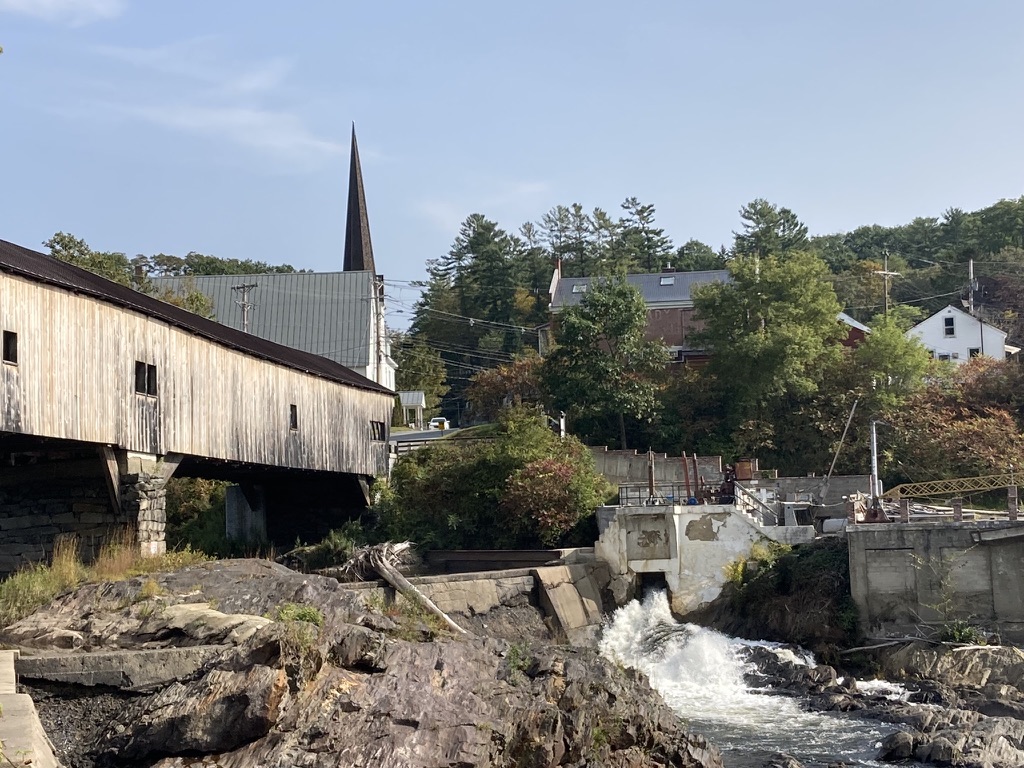
The Ammonoosuc trail follows – you guessed it – the Ammonoosuc River. While checking out the three newest miles of the trail east of Littleton, I met a couple I know from the NH Rail Trail Coalition. We were pleased to see that the new section, between Cottage Street and Oxbow Drive, has a great surface that will be especially helpful to anyone biking the Cross New Hampshire Adventure Trail. The following day, I met up with yet another NHRTC colleague while on a gravelly Ammonoosuc stretch between Lisbon and Bath. That surface is in the process of being upgraded from gravel to a smoother crushed stone. Can’t happen soon enough, as far as I’m concerned. My feet took a bit of a beating that day. I gave them a rest as I ate my lunch under the picturesque Bath covered bridge.
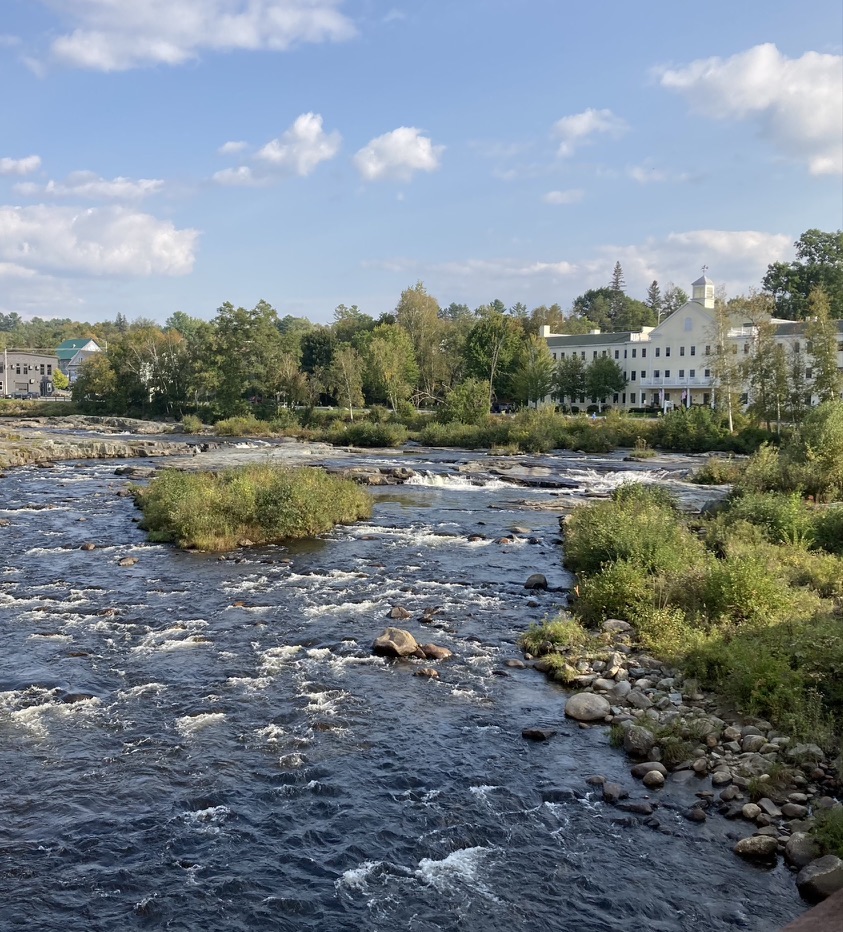
Ammonoosuc River in Littleton NH. All photos by Ellen Kolb/Granite State Walker.Bath NH: lunch spot along the Ammonoosuc River, under the covered bridge.
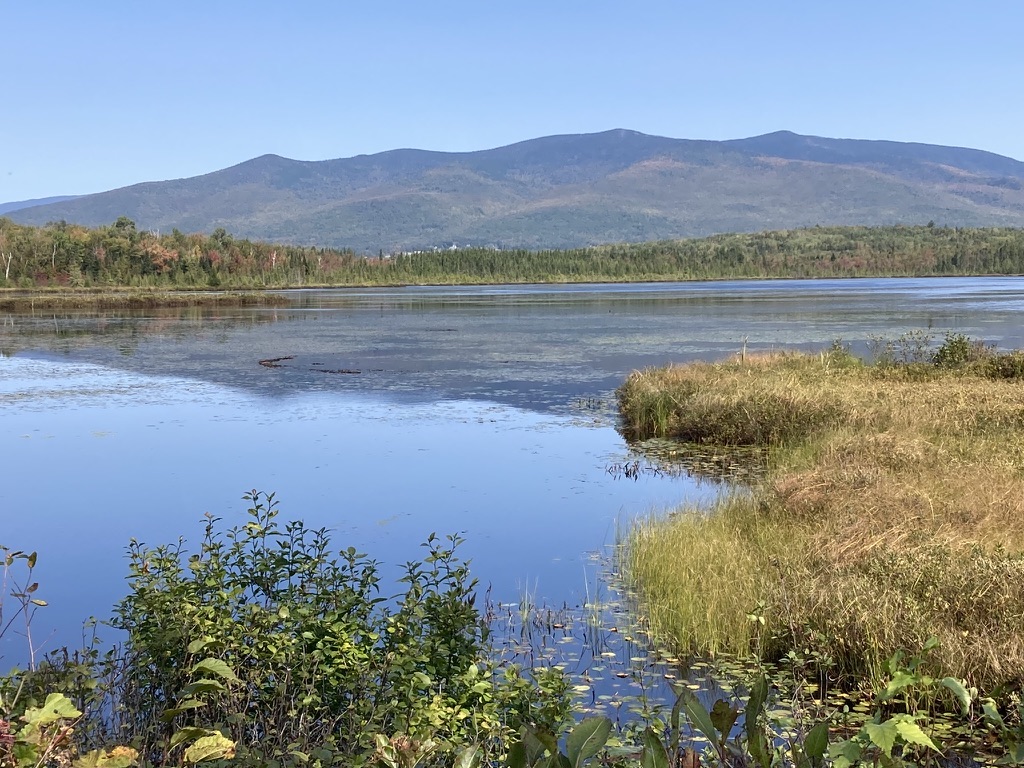
I was in the Pondicherry Wildlife Refuge a few months ago, when Joe-Pye weed and Queen Anne’s lace were blooming all along the Presidential rail trail. When I returned in early fall, nearly all the blossoms were gone, except for a couple of hardy little asters holding out against the equinox. Milkweed pods had burst and left their seeds floating across Moorhen Marsh. Frost had nipped the north country and its mosquitoes, making the walk to Cherry Pond even more pleasant than usual. My last view of the pond had been when it was covered with water lilies. This time, the pond was a mirror for Mt. Starr King and the Pliny Range.
If I were to search this blog’s sixteen years of posts, I’d probably find a dozen photos of the views from the Cherry Pond observation deck. Even when I know I’m standing in the same place and pointing the camera in the same direction as I did on an earlier walk, I’ll get a unique image: different light, different season, different shades of earth and sky.
Cherry Pond in the Pondicherry Wildlife Refuge, on the Presidential Rail Trail, Jefferson NH.
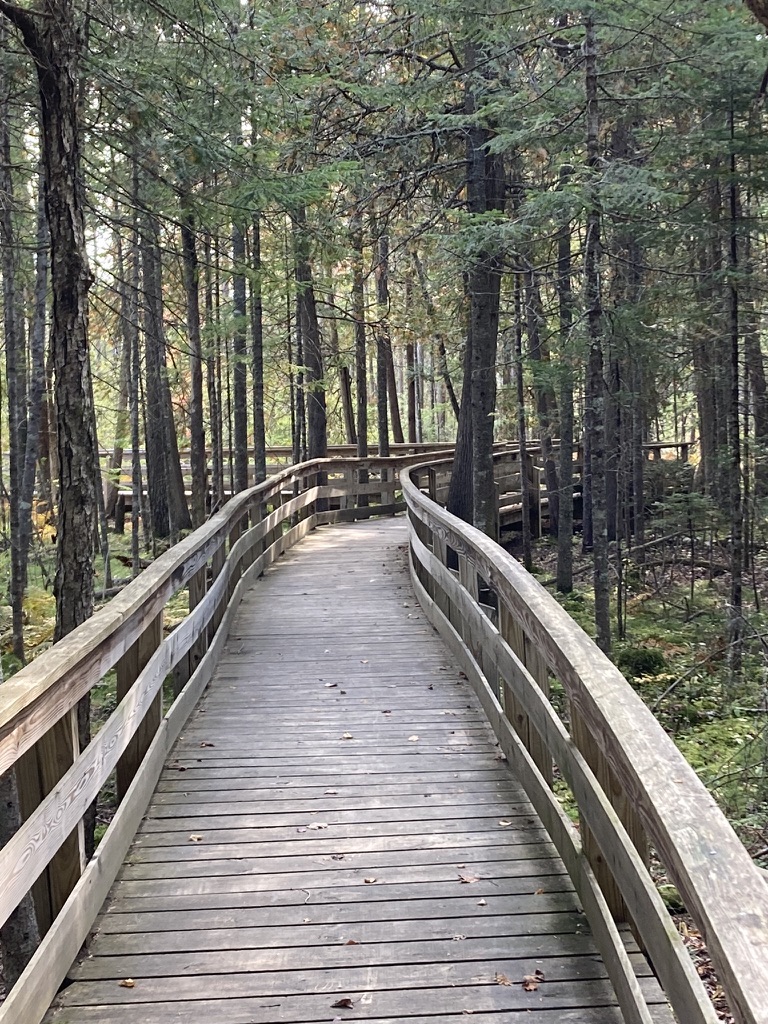
I decided to re-visit Mud Pond trail, also in the wildlife refuge but north of Cherry Pond, with its trailhead off of NH Route 116. I was there some years ago when it was brand-new and awaiting finishing touches. Now, it’s a small gem. Bonus: it’s designed to be accessible to anyone in a wheelchair, with switchbacks and boardwalks and easy grades along its half-mile length. It ends at Mud Pond, which really deserves a better name. It’s pretty and peaceful, and the observation deck must be a birdwatcher’s dream.
The trail to Mud Pond in Jefferson is designed for maximum accessibility, leading to a good spot for birdwatching.
Walking for a cause
Mid-October, I walked 13 miles on the Rockingham Recreation Trail in Auburn, Candia, and Raymond with a group raising funds for a shelter in Manchester. We couldn’t have picked a better October day. From a foggy sunrise over Lake Massabesic all the way to full midday sunshine in Raymond, I enjoyed good company.
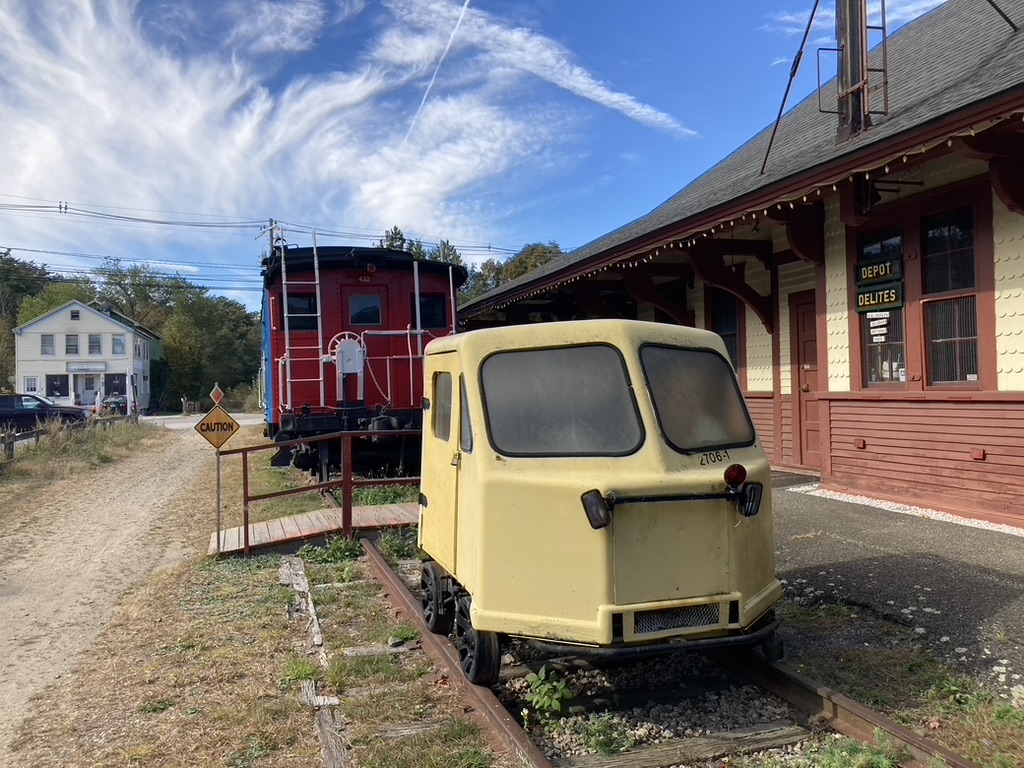
I hadn’t passed by the old Raymond Depot in awhile, and it was fun to see it again. The littlest rail car – I call it a putt-putt, though it probably has a more dignified name – always looks a little lost on the siding, dwarfed by the more conventional rail cars nearby. They’re all part of the old rail line’s history, so they all belong there.
Raymond Depot along Rockingham Recreational TrailA golden October day on the Rockingham trail
One piece at a time
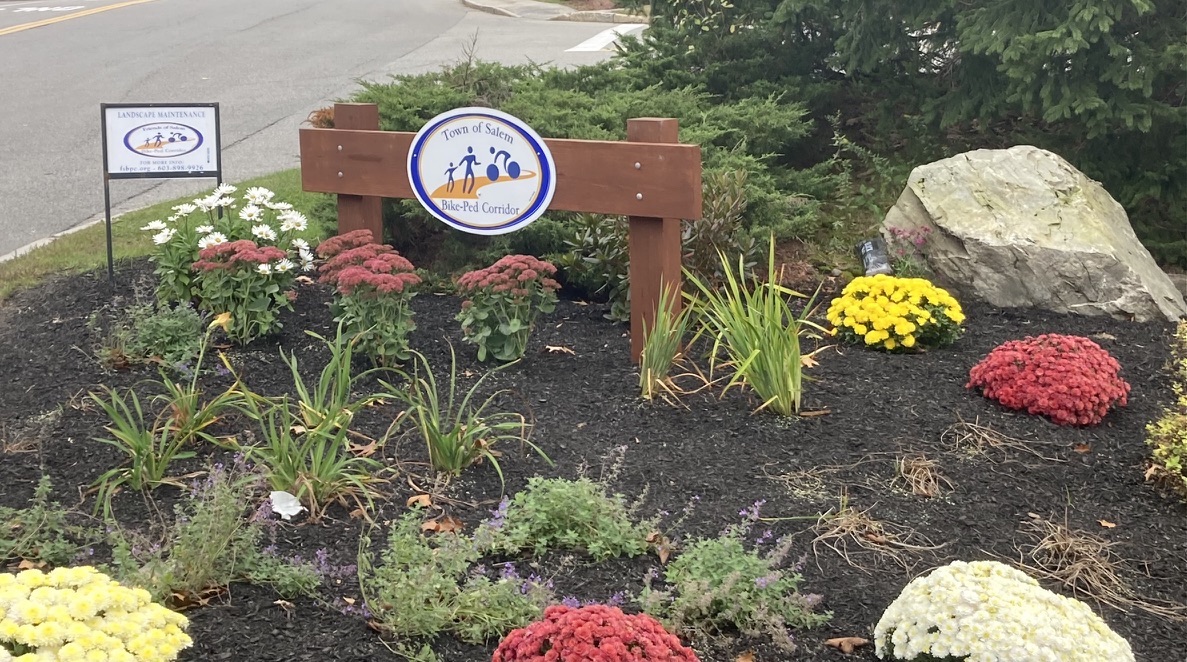
Just a few days ago, I attended a ribbon-cutting for a trail in Salem, New Hampshire. A trail segment, to be more precise. A 300-foot segment, if you must know.
Okay, let the eye-rolls commence. But I drove the better part of an hour to be there, because getting that segment finished took years, and I wanted to thank the people who had made it happen. This is the Salem (NH) Bike-Ped Corridor at the Massachusetts state line. Its significance: it’s the south end of what will someday be the Granite State Rail Trail extending from Salem all the way to Lebanon, just this side of Vermont.
A piece of the Salem trail is already in use further north of the newly-christened segment, extending into Windham and Derry. This is the same old rail line that includes what’s now the Londonderry rail trail, which will someday connect with the South Manchester trail, which will someday connect with yet-to-be-built trails in Hooksett and Bow and Concord, finally connecting with the Northern Rail Trail that’s already complete from Boscawen to Lebanon.
This is how long trails are built, whether they’re remote or urban, flat or mountainous: one piece at a time, even if some of those pieces are only be 300 feet long. Over time, those pieces add up.
Pocket park on the Salem Bike-Ped CorridorDignitaries and trail advocates celebrate a newly-completed segment on the Salem Bike-Ped Corridor.
I seldom get to Salem, so I spent time after the ribbon-cutting ceremony walking south along the Bike-Ped corridor into Methuen, Massachusetts. It was easy to ignore the traffic noise from nearby heavily-developed Route 28. Instead, I concentrated on the sights, sounds, and fresh clean smells of the wetlands and pocket parks along the way.
“Past peak,” say the foliage reports. Don’t you believe it.
The more I hike around the Granite State, the more I become aware of the pieces of history visible along the way. There are stories everywhere, told in many ways: markers, signs, cellar holes, even concrete footings from long-gone towers and cabins. The recent dedication of a historical marker not far from my home sparked this post, which I wrote for nhrtc.org, the website of the New Hampshire Rail Trails Coalition.
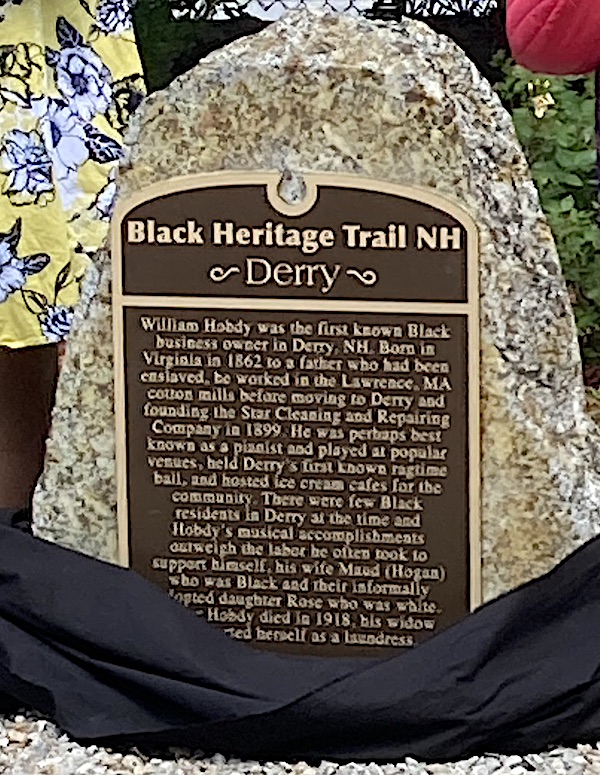
You’ll be well rewarded as you travel along New Hampshire’s rail trails if you keep your eyes open for reminders of Granite State history and heritage. You’ll find informative markers, plaques, and signs celebrating people and events. Among the newest is the Black Heritage Trail marker honoring William Hobdy, mounted on the Derry Rail Trail just south of Broadway (NH Route 102).
On the Black Heritage Trail in New Hampshire: a tribute to William Hobdy, businessman and entertainer. Photo by Ellen Kolb
The dedication of the Hobdy marker was a community-wide event drawing a crowd to central Derry. William Hobdy lived in town in the early 20th century and became owner of a small business. His music brought him his greatest renown, as his ragtime piano skills graced local venues. Now, the marker relating his story is a prominent feature on the Derry Rail Trail in the town center.
On the same trail, keep an eye out for artwork framing a poem by Robert Frost, who once taught at nearby Pinkerton Academy before earning worldwide fame for his poetry.
Another Black Heritage Trail marker is at Potter Place in Andover, where a restored depot is a scenic highlight along the popular Northern Rail Trail. Andover resident Richard Potter was a 19th-century entertainer who gained nationwide fame as a ventriloquist, magician, and humorist, but his story didn’t end there. The marker honoring Potter can inspire you to learn more about him and his time.
Canobie Lake Station marker along the Salem NH bike-pad trail. Ellen Kolb photo.
Thanks to the enthusiasm of rail trail fans in conjunction with local historical societies, some trails celebrate a heritage of passenger rail to popular parks and bygone resorts. Kiosks in the towns of Troy and New Boston display reproductions of train schedules from the days when Boston residents would come to New Hampshire via train for vacations and day trips. In Salem on the Bike-Ped trail, a marker recalls train service to Canobie Lake and Rockingham Park.
Sometimes, a sign will spotlight a feature of the trail itself. Watch for an informational sign along the Sugar River Trail in Newport about the unusual Pier covered bridge, built tall enough to accommodate the trains that used to ply the route. Motorists on nearby roads can’t see the bridge, but trail users get to travel right through it.
These clues to local history add something special to an excursion on rail trails. Every trip can reveal something new.