I took my husband up on his invitation to join him and his running buddies in Mason, New Hampshire this morning. Beautiful day, lots of sun, 40 degrees or so at 8 a.m. We agreed to meet back in the Parker’s Maple Barn parking lot at 9:30, and I left the runners to follow their own paths. I walked toward the rail trail that runs through Mason from the Massachusetts border north to Wilton and then west to Greenville.
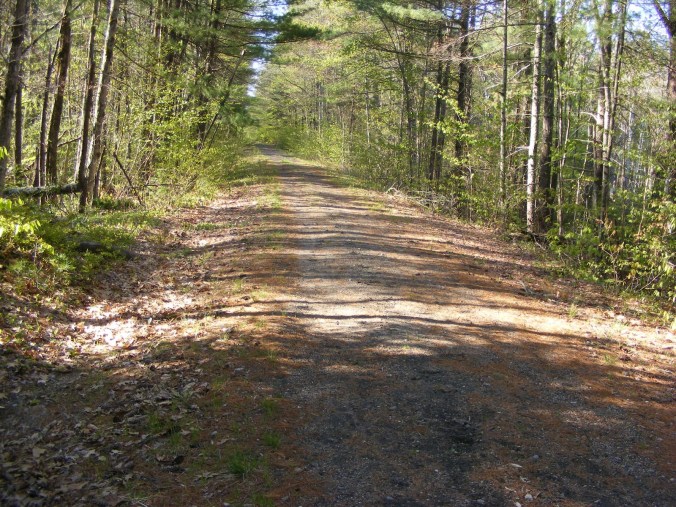
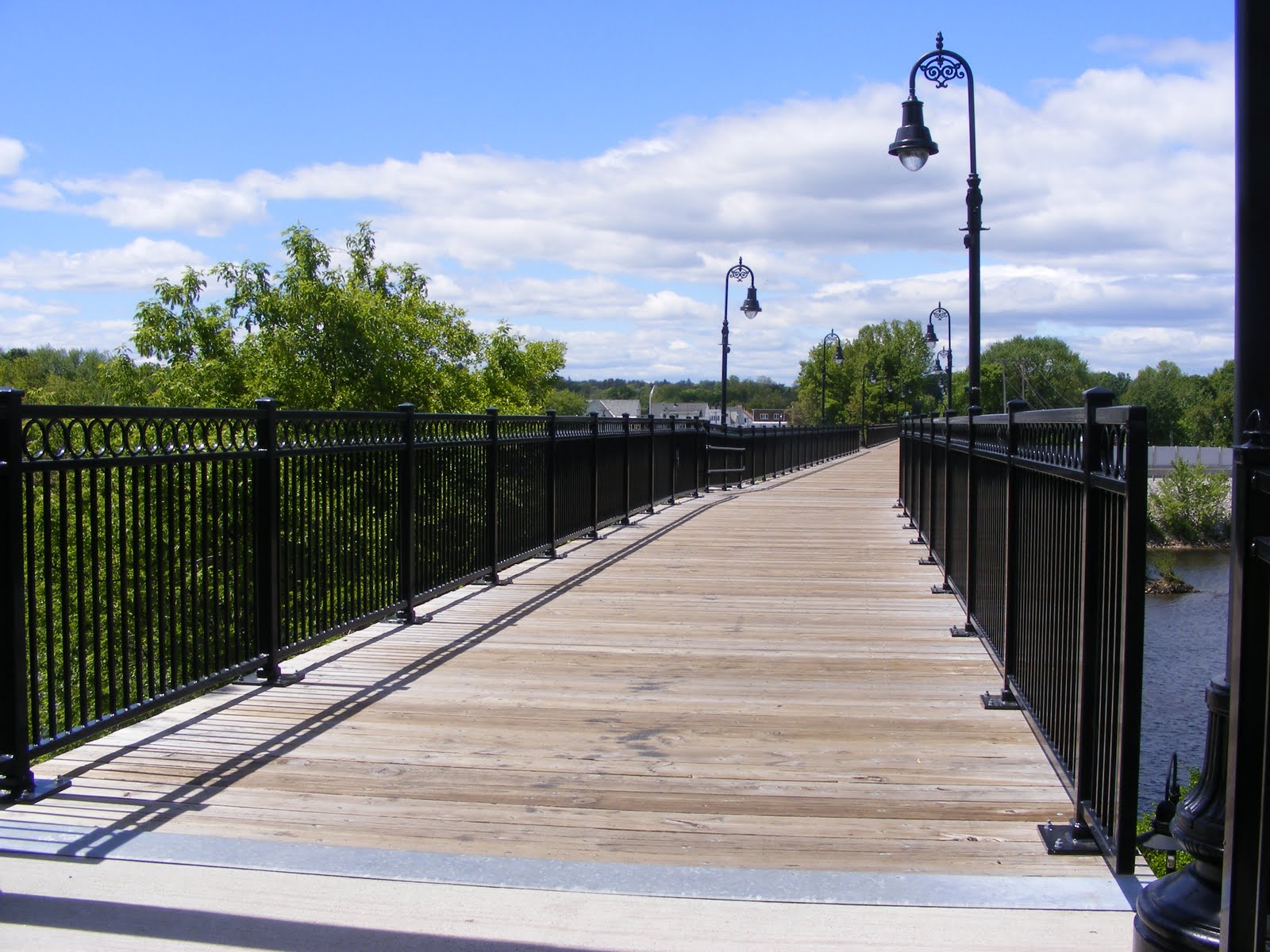
Mason (NH) rail trail. Ellen Kolb photo.
Mason has hills. Not steep hills, but hills nonetheless. Brookline Road heading northwest from Parker’s makes a steady climb up to County Road and continues fairly level to a sharp left turn. At that point, I went straight onto unpaved Scripps Road, a dead end with no-parking signs all along one side. Soon, I emerged onto the rail trail.
(Update, 2020: that access point is no longer a formal trailhead. Please respect private property. A trailhead with parking is at the trail crossing on Depot Road, less than a mile south of Scripps via Brookline Road. Parking for the trail is also available where it crosses Pratt Pond Road.)
This is a decently-maintained trail, wide as a boulevard, with unremarkable but pleasant woodland scenery. It must make a great snowmobile trail in winter.
I know from long-ago hikes on more northerly segments of the trail that I could have walked in peace all day if I’d had the time. I’m sorry I couldn’t stop today at Pratt Pond, probably the prettiest spot on the Mason trail.
Although close to town roads, the trail’s peace and quiet are remarkable. Aside from a plane passing far overhead, the only sounds were birdsong and wind in the trees.
I walked back to Parker’s Maple Barn and met up with my husband and friends for an excellent breakfast. As is usually the case with Parker’s on a Saturday morning, there was a short wait for a table. Believe me, it’s worth it. (Try stuffed French toast and a mug of maple coffee. Trust me.)
I spent a couple of hours at Pawtuckaway State Park in Raymond yesterday, still waiting on southern New Hampshire’s first snowfall of the season. Great time for a visit! I came in the “back” way, via Reservation Road in Deerfield, parking at the Round Pond Trailhead alongside a couple of other vehicles. I had no company on my walk to Tower Road and the fire tower. I’d never been to the tower without finding dozens of other hikers there, and I rather liked having the view to myself.
I enjoyed the sunny December day, but there was too much haze for me to catch sight of the Boston skyline.
(Update: Pawtuckaway State Park’s popularity skyrocketed during the Covid pandemic, prompting the state of New Hampshire to institute a reservation system for parking and beach use. The system has outlived the pandemic. Especially on weekends and holidays, check the park’s website for reservation information.)
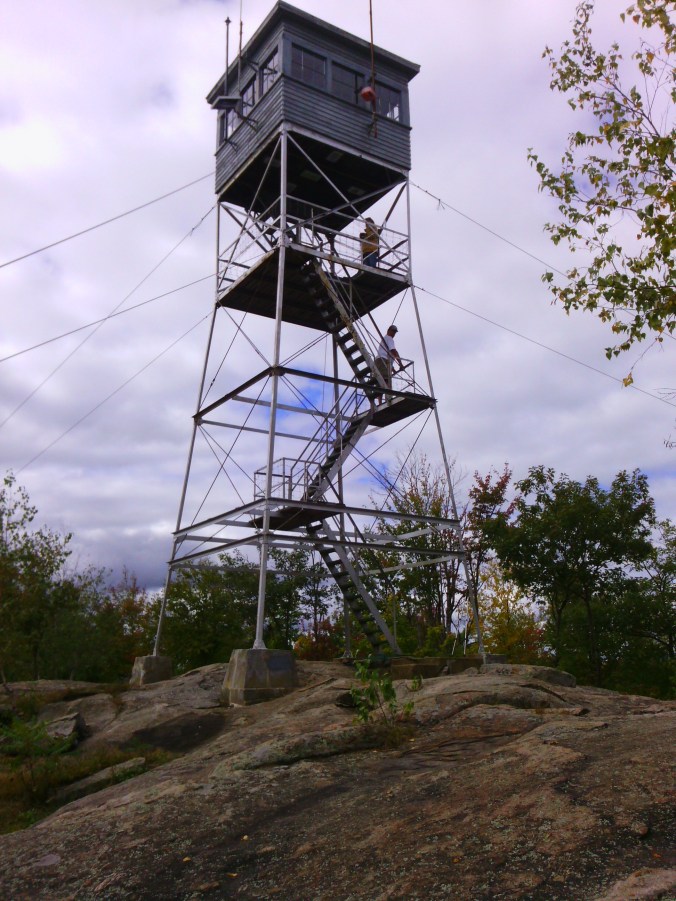
Fire tower at Pawtuckaway State Park, 2010. It has since been rebuilt.
The Oak Hill trails in Concord, New Hampshire branch out from a parking area on Shaker Road, where ten cars (maybe a dozen, in a pinch) can fit comfortably. From NH Route 132 in the northeast part of town, turn onto Shaker Road and continue for about 2.4 miles. Watch for a sign on the right with a parking area.
The forested hill is laced with trails, with good vistas here and there. The fire tower at the summit, on the Concord-Loudon line, is a bonus, and you can get there by following Tower Trail, which is about two miles long and has signage along the way. Print out your map from the City of Concord’s website so you can find your way around the trail network.
My trail report from a visit on December 18, 2010:
Tower Trail is free of obstructions. The few bridges are intact. Oak Hill is still snowless, and the trail itself is ice-free except for a few small areas in the last few hundred yards leading to the tower. The frozen ground is covered with leaves that can be a bit slippery, and the surface is a bit uneven with rocks and roots. In other words, this is a typical woods walk.
The last quarter-mile or so follows a power line straight to the fire tower, which is dwarfed by a pair of cell towers. The cab is unstaffed and locked this time of year. I was able to climb to the platform just below the cab, stopping at each landing to wonder just what the fire warden was supposed to survey. I had to get to the platform before the view and the breeze really opened up. Warner’s Mt. Kearsarge dominated the view to the west-northwest. There are hills in all directions, none of them snowcapped yet, though my view was limited by distant haze.
It’s about 500 feet of vertical rise from the trailhead to the tower, with a gentle grade. The hike took me 50 minutes each way, and a more fit walker could undoubtedly cut that time considerably. The full trail network on the hill covers about 7 miles, so a hiker could easily spend a day exploring the area. There are no toilet facilities at the trailhead.
The trailhead is less than 15 minutes’ drive from the State House, and the trail is in great shape. I’ll be back.
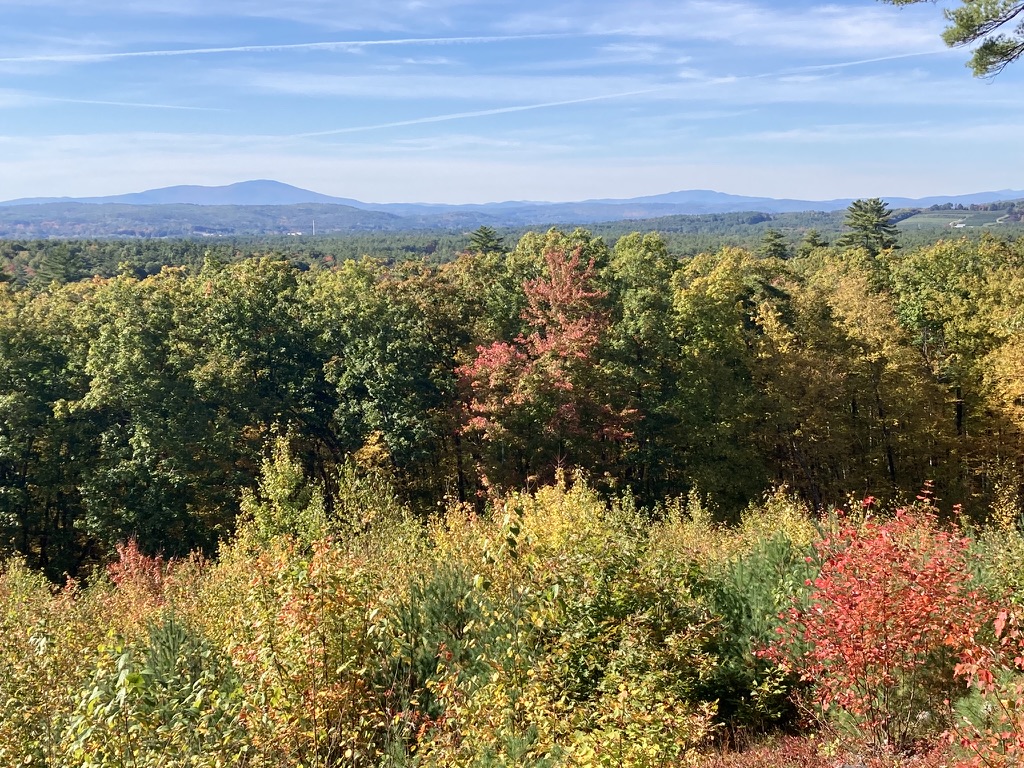
Looking west from the Oak Hill fire tower in Concord NH, the next active fire tower is on Mount Kearsarge (at left) in Warner.
Update, 2026: If the goffstowntrails.com website isn’t available, look for information on the Uncanoonucs and other Goffstown, New Hampshire trails at goffstownlibrary.com.
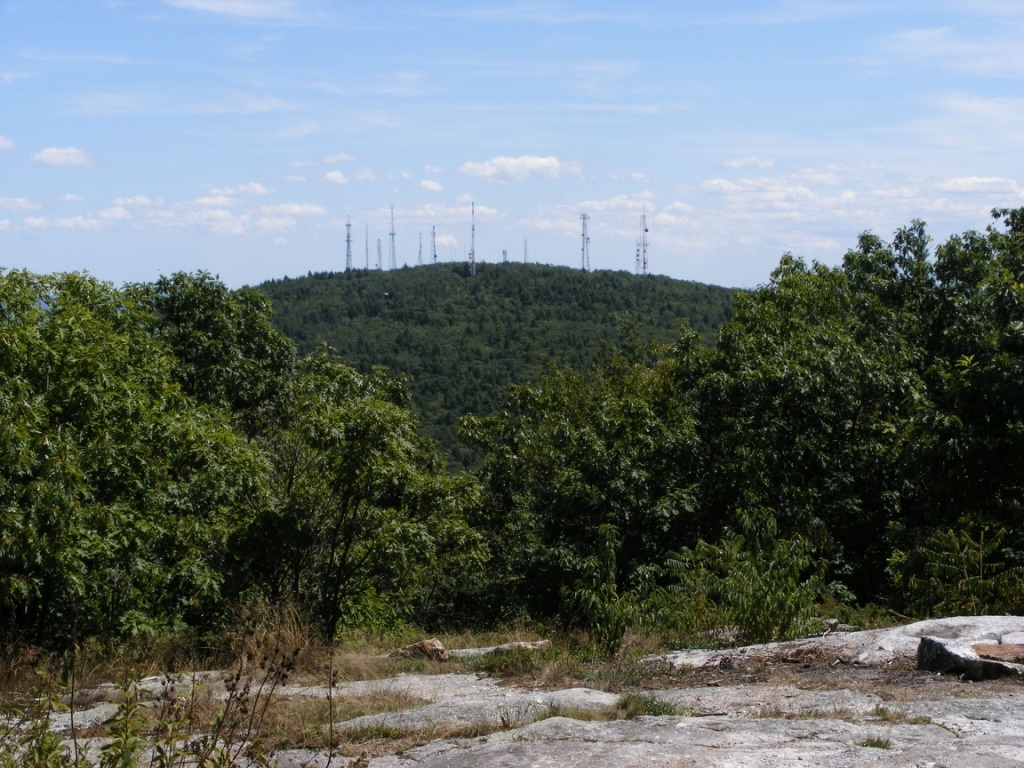
The twin Uncanoonuc hills in Goffstown, New Hampshire are my landmarks for knowing I’m nearly home whenever I come back from even a short trip out of my area. North Uncanoonuc looks forested and fresh, while South has 14 antennae and cell towers on its summit, making it look a bit like a geographic porcupine. I can’t complain too much about the towers, since I like having cell service & similar conveniences. Any map I consult calls these the Uncanoonuc Mountains, but when you read that, bear in mind that these “mountains” top out around 1300′.
North Uncanoonuc is always pleasant, with good views, no power lines, & no towers. Today, though, I wanted to check out the trails on the South mountain. Goffstown has produced a terrific map available on the town library’s website showing the trails that snake over & around both peaks. Mountain Road between the hills has several parking areas for hikers, and the entrance to the Reservoir road off Mountain Road now has a parking area with a map kiosk.
South Uncanoonuc Mountain with all its communications towers, seen from nearby North Uncanoonuc. Ellen Kolb photo.
I started up South Uncanoonuc from the kiosk for a short late-afternoon hike, carrying the map I had downloaded & printed. Conditions are typical for November. South’s trails are covered with slippery oak leaves, and a few of the boggy spots already have a thin skin of ice. Major trail intersections have either snowmobile signs or trail markers. Most minor trails as shown on the map are easy to spot, though they’re unsigned. A power line cut across the slope includes a well-defined trail, which today saw bike traffic along with a few hikers. It was a great day to enjoy the view of the city of Manchester from South’s summit ledges. I could almost forget that a cell tower was right behind me.
If I had had more time, I could have continued down the other side of South Uncanoonuc on either of two trails that end at Uncanoonuc Lake. A full morning or afternoon could easily be given to wandering these trails and visiting both summits. Bring water & snacks – the closest store & restrooms are on Mast Road, a couple of miles north of the trail kiosk on Mountain Road. There’s a paved road from South’s summit to Back Mountain Road, and if you want a good workout without going into the woods, you can drive to the summit (no good parking at the base)and walk down to the base & back. But why would I want to avoid the woods on a day like this?
It took a whole lot of people, headed by Manchester resident Helen Closson, to make a pedestrian bridge out of the abandoned rail bridge across the Merrimack River in Manchester, New Hampshire. Closson called the project “Hands Across the Merrimack” while it was underway, and whatever name the pedestrian bridge may be given officially, that’s the name I’ll remember.
I’ve been on the bridge before, just for the fun of crossing over the Merrimack on foot. Today, after some business in town, I took advantage of the sunny afternoon to walk the rail trail clear across Manchester’s West Side. This is Manchester we’re talking about, so “clear across” means about two miles.
Starting from the baseball stadium where the Fisher Cats play on the river’s east side, a paved walkway runs parallel to the Merrimack and shortly comes to a fork. Going right would have brought me under the rail trail and onto some private property. Going left brought me around a sweeping curve to the approach of the Hands Across the Merrimack bridge.
I was a bit startled to find a sculpture of a steer just short of the bridge. The plaque mounted nearby noted that the statue was a tribute to workers & entrepreneurs like the ones from the former JacPac meat processing plant located nearby, now the site of a hospital expansion.
Vandalism has become an issue along the trail, judging from some news reports I’ve read. It looked good today, though. I’m sure that’s an ongoing effort by people who care. The trail is paved its entire length, and the pavement’s in good shape.
The bridge is at the southeast end of a trail that parallels the Piscataquog River. For now, the northwest end of the trail is near what I call the Kelley Street bridge (Nazaire Biron Bridge on my map) that links the West Side with the Pinardville neighborhood. There’s a very hazardous crosswalk on Main Street, but the few other road crossings are in quiet neighborhoods. The trail, like the rail line before it, goes on a bridge over Second Street, avoiding a road that’s just as busy as Main Street.
The Piscataquog River snuck up on me. I cleared Main Street & followed the trail behind a house where there was a cheerfully noisy party going on. As the music from the party faded behind me, I became conscious of the river’s sound, and soon the river was in view. A few weeks ago, we had heavy rains, and this river was particularly pesky for the people living along it. Today, though, it was a tame & pretty thing. Several dirt trails ran steeply from the trail down to the river. I stayed on the pavement, worried that I’d twist an ankle trying to negotiate the slope in my sneakers.
Eventually, I came to some ball fields, where a softball game was just wrapping up. Soon I was in sight of the ugly red bulk of West Side Arena. The building’s homely appearance belies its worth as an athletic facility for what seems like every kid on the West Side. Soon I passed under the Kelley Street Bridge and reached what is now the end of the trail.
Once upon a time, this rail line crossed the Piscataquog near Kelley Street, and then paralleled the river (on its north side now) through Goffstown & into New Boston. Patches of the line have been developed into trails. I’ve been on one segment in New Boston near where the middle & south branches of the Piscataquog converge — a beautiful spot. In Goffstown, determined residents have turned part of the old railbed into a trail, and they continue to try to finish the link between New Boston & Manchester.
[Update, 2015: that link, a bridge over the Piscataquog River, was completed in 2015. Trail users can go from Manchester’s baseball stadium all the way to Goffstown center.]
For now, though, all I saw after crossing under Kelley Street was a fenced-off trestle hung with “Keep Off” signs. I suspect that tight municipal budgets and concerns about liability will keep that trestle from ever being turned into a pedestrian bridge. Of course, that’s what I used to think about the bridge across the Merrimack. [Update: five years after I wrote this, the Piscataquog River trestle was indeed rebuilt, thanks in part to the generosity of the Singer family.]
This is not a path I would take after dark. I have no problem visiting on a weekend afternoon in broad daylight.
The December 2008 ice storm in southern New Hampshire, now four months past, has become a reference point for all my observations of southern NH trails this spring. I recently visited Miller State Park and Pack Monadnock to see how recovery is going.
I can’t begin to speculate on how many people it has taken to return trails around here to usable condition. The auto road, still gated to keep cars out, is clear all the way to the summit. The road sports a new edging of wood chips and sawdust from all the overhangs and broken limbs cleared from ice-damaged trees.
Auto road at Miller State Park, Peterborough, NH, showing tree damage from ice storm.
The lower end of the auto road is now clear, with deadfall and snapped tree limbs piled at the road’s edges. Hardwoods predominate at the base of the mountain, and they took the brunt of the storm damage. The destruction must have seemed overwhelming to the first people who came by to check it out just after the storm. The cleared road testifies to a lot of effort since then. Even so, I was stunned for a few minutes when I got out of my car and had my first look around.
The few other cars in the lot when I arrived belonged to members of a trail-clearing party of Friends of the Wapack. The group’s web site says that there will be a work party somewhere along the trail every weekend this season, and this must have been Pack Monadnock’s turn. I heard a chainsaw being used in the woods off to my left as I descended from the summit later in the morning.
I decided to walk up the auto road, wondering just how blocked the Wapack and Marion Davis trails must be. I brought my camera in the hope of seeing some wildflowers growing low to the ground, but there has been way too much cleanup activity along the road to allow anything to sprout along the edges. I don’t doubt that there are plenty of flowers farther from the road and along the trails. I did see lots of buds on trees and shrubs, reminders that the forest will recover as it always does after one of Nature’s big events. One tree had lost its two main limbs and looked pretty sorry, but that didn’t stop a bird from working on a good-sized nest in one of the branches that was left.
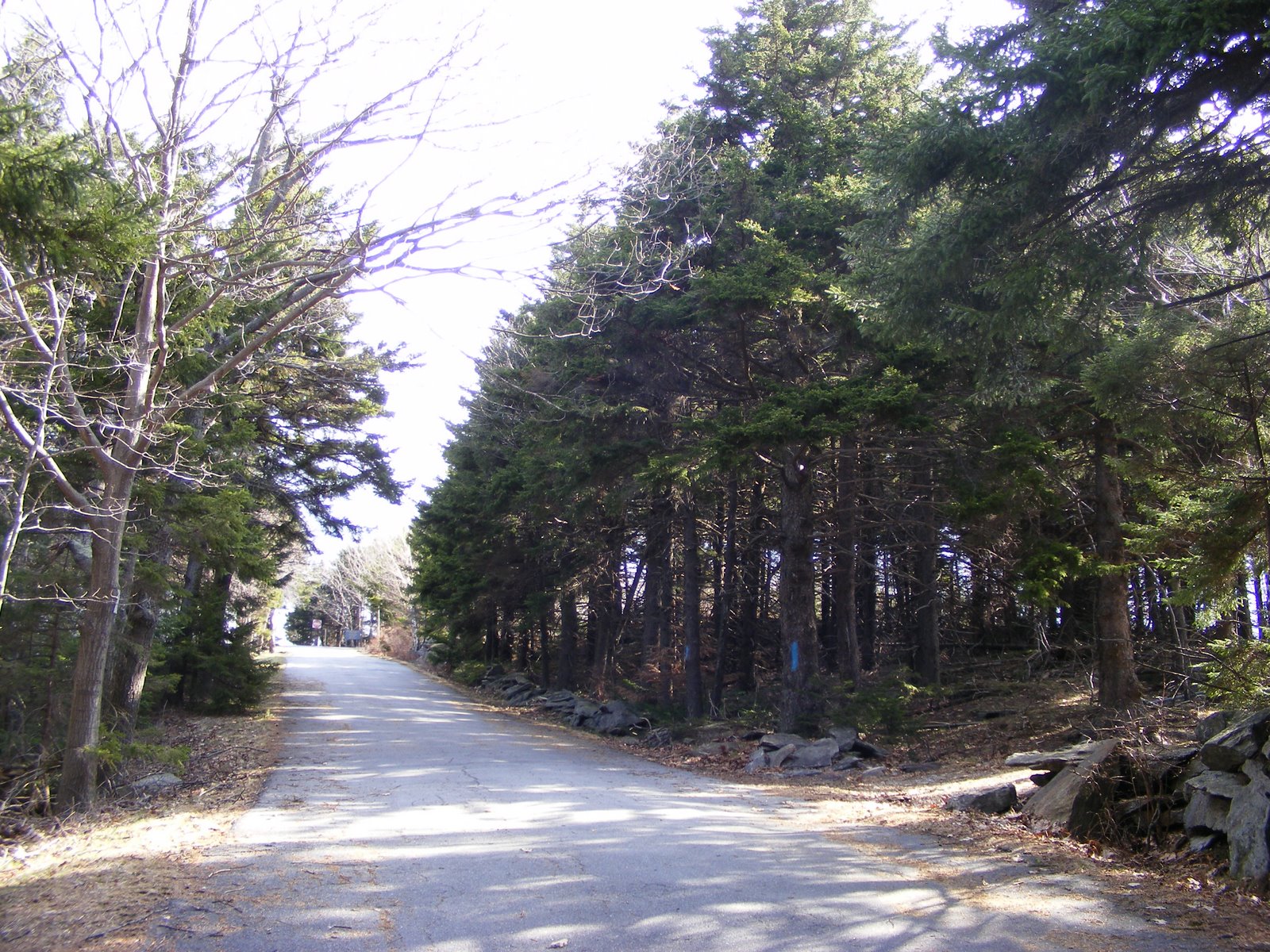
The road’s a mile & a quarter long, and it rises 700 feet. Towards the summit, where evergreens take over from the oaks & maples & birches, there is much less tree damage. The evergreens seem to have shrugged off the ice and bounced right back. The last few hundred yards of the road have blue blazes on nearby trees, and that made me wonder if the Marion Davis trail has been re-routed for a distance.
Miller State Park auto road: evergreens near the summit weathered the ice storm much better than the hardwoods at Pack Monadnock’s base.
The summit, without summer crowds, was a fine place to be. The view of Monadnock always pleases me, even on a hazy day. The cool morning was giving way to an 80+ degree afternoon, with a brisk breeze up on the landing of the fire tower. I later perched on a picnic table with my water bottle, looking over towards North Pack in its shades of green & grey. Close up, the woods show damage. From a distance, they look like they’ll be around long after I’m gone, which of course is exactly the case.
When I was here last fall, New Hampshire Audubon had volunteers at its raptor observatory near the summit, identifying birds in the fall migration. I was lucky enough to catch sight of a golden eagle that day. This weekend was different, with migration season long past. There wasn’t so much as a turkey vulture soaring overhead. I settled for chickadees in the woods.
One Subaru – or more precisely, one Subaru’s driver – drove around the closed gate to the auto road, surprising me on my way up. Aside from that, I had very little company: a half dozen dog walkers, one intrepid bicyclist, a lone runner. I was therefore unprepared for the sight in the parking lot when I finally got back down a little past 11 a.m.: more than 40 cars, with more coming in by the minute. That suggested to me that the Wapack Trail up the mountain must be in fine shape, since all the people from those cars had to be somewhere, and they weren’t on the auto road.
The ice storm left scars on the land, but recovery is underway. I’m grateful to all the volunteers whose work is bringing the trails back to life.








 Granite State Walker